
A course sales funnel is the staged path a stranger travels to become a paying student, moving through attract, engage, nurture, convert, and retain. The first move that matters most: pick one lead magnet, whether that's a webinar or a free resource, and build a single opt-in page around it before touching anything else.
TL;DR:
- Focusing solely on traffic is ineffective; fixing checkout friction, proof, and offer clarity can significantly increase enrollments.
- The most effective funnel type depends on your course price point, with webinars suited for courses over $500 and freebies for under $200.
- Segmenting prospects based on entry source and engagement level boosts nurture effectiveness and improves conversion rates.
- Integrating all funnel components into one platform reduces breakdown points and ensures smooth tracking and automation.
- Testing each stage, especially checkout and offer messaging, is critical for identifying leaks and optimizing overall sales performance.
Table of Contents
- What Is a Course Sales Funnel, and What Does Each Stage Need to Do?
- Which Funnel Template Should You Build First?
- What Pages and Automations Does a Complete Funnel Need?
- Which Metrics Actually Tell You Where the Funnel Is Broken?
- How Should You Price, Structure Payments, and Add Upsells?
- Should You Run a Launch or Build an Evergreen Funnel?
- How Do You Segment and Target Different Buyer Personas?
- How Does the Funnel Connect to Your CRM and Marketing Tools?
- What Mistakes Quietly Kill Course Sales Funnels?
- What Do Successful Course Funnel Templates Actually Look Like?
- A Course Creator's Practical Take: Three Mistakes to Fix First
- How Aria Fits Into Your Funnel Without the Extra Subscriptions
- Sources
- FAQ
What Is a Course Sales Funnel, and What Does Each Stage Need to Do?
Most creators picture a funnel as a sales page with an email list attached. That's the shallow version. A real course sales funnel runs through five distinct jobs, and each one has its own staged model and its own success metric. Confusing the stages is why so many creators pour traffic into a leaky system and wonder why enrollments stay flat.
Attract is where strangers first meet you, through a blog post, a paid ad, a podcast guest spot, or a social clip. The metric here is simple: what percentage of visitors becomes an opt-in? It's the offer on the landing page.
Engage happens the moment someone hands over their email. This is the delivery of your lead magnet and the first proof that you keep promises. A slow, confusing delivery page kills trust before the relationship even starts.
Nurture, sometimes called the decision stage, is where segmented email sequences do the heavy lifting: teaching, showing proof, and addressing the objections that keep people from buying. Generic newsletters underperform here compared to sequences built around what a specific segment actually needs to hear next.
Convert is the sales page, the checkout, and the payment options in front of a buyer at the exact moment they're deciding. This is also the stage where checkout friction quietly kills more sales than weak sales copy ever does.
Retain covers onboarding, community, and the upsells that turn a one-time buyer into a repeat customer with a higher lifetime value.
The five stages, at a glance:
- Attract: traffic sources feeding the top of the funnel, measured by visitor-to-opt-in rate
- Engage: lead magnet delivery and the first trust signal a subscriber sees
- Nurture: segmented email flows carrying proof and objection handling
- Convert: sales page, checkout flow, and payment options
- Retain: onboarding, community, and upsells that extend lifetime value
Which Funnel Template Should You Build First?
You don't need five funnels running at once. You need one that fits your audience size, your price point, and how much time you can actually spend running it. Practical funnel templates used by course creators tend to fall into five patterns.
- Webinar funnel. Entry page promises a specific outcome in a live or automated session, delivery happens through the webinar itself, nurture is a short pre-webinar email sequence, and the pitch happens at the end of the presentation. This works best for mid-to-high ticket courses ($200 and up) where buyers need to see you teach before they trust you. Well-run webinars in creator funnels often convert somewhere in the 5% to 15% range, which makes them one of the highest-converting entry points available.
- Freebie-to-nurture funnel. A simple opt-in exchanges an email address for a checklist, template, or short guide, then a 5 to 7 day email sequence nurtures toward a sales page. This suits lower-ticket courses under $200 and creators just starting to build a list.
- Challenge funnel. A 3 to 5 day free challenge builds momentum and community inside a group or short email series, ending with an offer while motivation is highest. Best for courses that require behavior change, like fitness, habit-building, or skill practice.
- Quiz or assessment funnel. A short quiz segments visitors by need or skill level, then routes each segment into a tailored nurture sequence. This fits creators with multiple course tiers or offers, since the quiz result does the audience segmentation for you.
- Cohort pre-sell funnel. A waitlist page collects interest ahead of a cohort-based course, nurture emails build anticipation, and the pitch opens with a deadline tied to the cohort start date. Works well for high-touch, limited-capacity programs.
Each template needs a minimum sequence to function: an entry page, a delivery mechanism, three to five nurture emails, and one clear offer. Skip any piece and the funnel stalls.
What Pages and Automations Does a Complete Funnel Need?
Building the funnel itself comes down to five connected pieces, and each one has a job that the next piece depends on.
The opt-in or landing page needs a benefit-first headline that states the outcome, not the mechanism, one or two social proof elements, and exactly one call to action. Multiple competing buttons on an opt-in page routinely drag down conversion, because every extra choice is a chance for a visitor to leave undecided. Study a few landing page examples before building your own, and check the landing page structure guide for the anatomy that tends to hold up across niches.
The delivery page is the first thing a new subscriber sees after opting in, and it needs to deliver a quick win, not just a download link. A short welcome video, clear access instructions, and one immediate action (like joining a community group) all build momentum before the first nurture email even arrives.
The sales page and checkout need FAQ sections that pre-answer the objections your support inbox already hears, a guarantee stated in plain terms, and a checkout process with as few fields and clicks as possible. This is the stage where payment plan options reduce friction and can noticeably lift completion rates, especially on courses priced above $500.
Email workflows carry the funnel between pages. A functional automation needs, at minimum: a welcome email, three to five nurture emails mixing education and proof, a cart abandonment reminder for anyone who starts checkout without finishing, and a scarcity follow-up near a deadline or cart close. The welcome sequence templates and broader email automation workflow guide both cover the triggers and cadence worth copying.
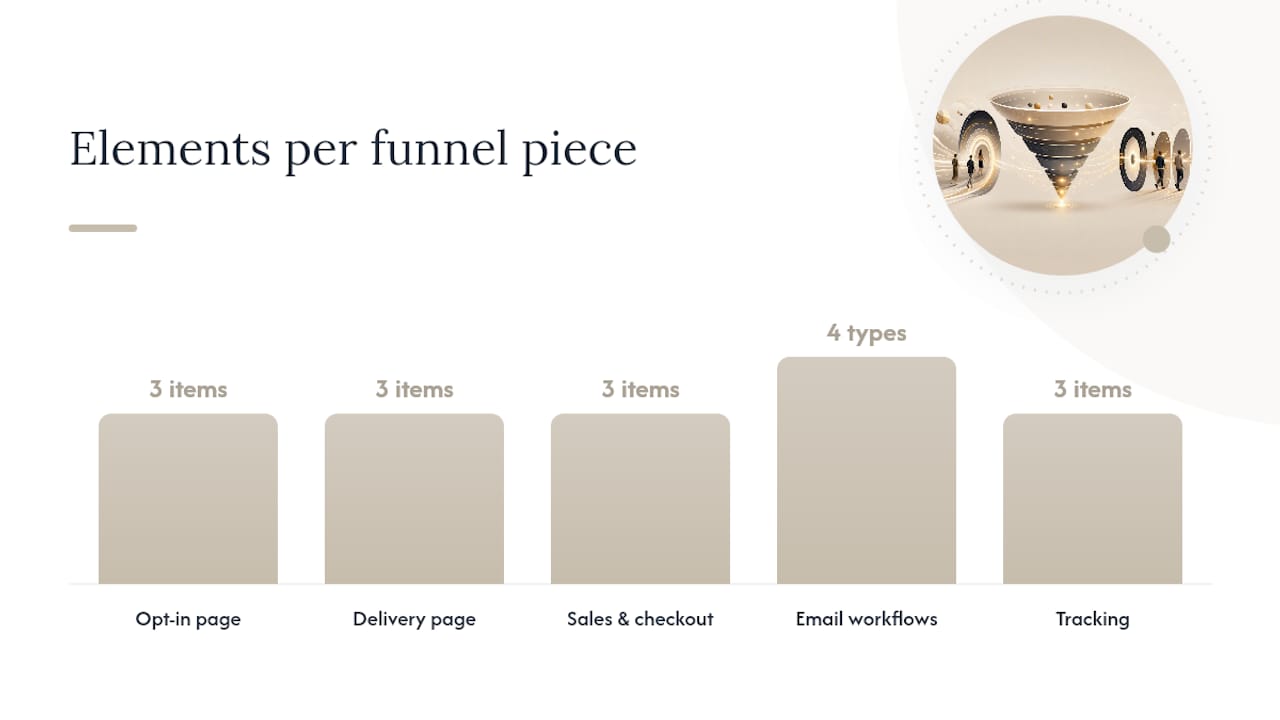
Tracking ties it together. Install pixels on every page, tag every link with UTM parameters so you know which traffic source actually converts, and set up simple segmentation, like tagging anyone who opened three or more emails as "engaged," so your nurture sequence can branch based on real behavior instead of guessing.
The full checklist:
- Opt-in page with one headline, one proof point, one CTA
- Delivery page with a fast first win, not just a file
- Sales page with a stated guarantee and pre-answered objections
- Checkout with minimal fields and a payment plan option
- Welcome, nurture, cart reminder, and scarcity emails in sequence
- Pixels and UTM tags on every entry point
Pro Tip: Build your cart abandonment email before you build your fifth nurture email. It typically recovers more revenue per hour spent than almost any other single piece of the funnel.
Which Metrics Actually Tell You Where the Funnel Is Broken?
Guessing which stage is underperforming wastes weeks. Measuring it takes an afternoon. Track opt-in rate (visitors to subscribers), show rate (registrants to webinar attendees, if you're running that template), offer click-through rate (emails to sales page visits), and checkout completion rate (sales page visits to paid customers).
- Opt-in rate: aim for 20% or higher on a well-targeted landing page
- Show rate: expect 30% to 50% of webinar registrants to actually attend live
- Offer CTR: watch for a sharp drop here, since it usually signals weak positioning, not weak content
- Checkout completion: track abandoned carts separately from page exits, since they mean different problems
A diagnostic framework worth following is simple: find the stage with the worst stage-to-stage conversion and fix that before touching anything upstream. If your checkout completion sits far below your offer CTR, more traffic won't fix a broken cart. It just means more people abandon it.
That prioritization matters more than most creators assume. If enrollment is low, the instinct is almost always to run more ads or write another blog post. But fixing the weakest stage-to-stage conversion first, often checkout or unclear offer positioning, tends to move revenue faster than adding traffic to a leaky system.
Test in this order: headline clarity on the landing page, the strength and specificity of your social proof, checkout friction (field count, page load speed, payment options), and whether adding a payment plan changes completion rates. Run one test at a time. Changing three variables at once tells you nothing.
How Should You Price, Structure Payments, and Add Upsells?
A single, clearly stated price outperforms tiered pricing when your course has one clear outcome and one clear buyer. Tiered pricing earns its complexity when you genuinely have different buyer segments, like a self-study track versus a track with live coaching calls, and each tier maps to a real difference in what the buyer gets.
Payment plans change the math more than most creators expect. Splitting a $997 course into three payments of roughly $349 doesn't just help cash-strapped buyers. It often widens your total buyer pool, since some people who'd never commit $997 upfront will commit to a smaller recurring amount. The tradeoff is cashflow: you collect revenue over months instead of upfront, which matters if you're funding ad spend from course sales.
Order bumps and one-click upsells are where a lot of underpriced funnels quietly make up ground. A checkout order bump, a small add-on offered right before someone completes payment, commonly converts in the 30% to 40% range on platforms built for this. A one-click upsell shown immediately after purchase, like a template pack or a live coaching add-on, works because the buyer just proved they trust you enough to pay.
Where to focus first:
- Use a single price for single-outcome courses; reserve tiers for genuinely different buyer needs
- Test one payment plan option before assuming it will hurt margins
- Add one order bump under $50 at checkout before building a full upsell sequence
- Reserve upsells for genuinely complementary offers, not unrelated products
Should You Run a Launch or Build an Evergreen Funnel?
The choice comes down to how much attention you can generate at once versus how much time you have to automate.
- Prefer a launch window when you have an active audience, a specific date you can build urgency around, and the capacity to handle a surge of new students at once. Launches concentrate effort into days, which suits creators without full-time marketing help.
- Prefer evergreen when your audience is smaller but steady, and you'd rather have a funnel run daily without your constant attention. Evergreen funnels trade launch-week intensity for consistent, lower-volume enrollment.
- Convert a launch into evergreen by taking your best-performing launch webinar or challenge and automating it, then replacing live urgency with a rolling deadline (like a cart that closes 72 hours after each person joins). Budget for evergreen traffic tends to be steadier and lower per-click than the paid push many creators run during a launch week.
A five-phase launch checklist is worth reviewing before your first attempt, since sequencing the pre-launch, open, and close phases correctly avoids the most common launch mistakes.
How Do You Segment and Target Different Buyer Personas?
Treating every subscriber the same is the fastest way to waste a nurture sequence. Someone who downloaded your free checklist because they're brand new to your topic needs different proof than someone who's been on your list for six months and just hasn't bought yet.
Segment by three signals: where someone entered the funnel (quiz result, freebie topic, webinar registration), engagement level (opened and clicked versus opened and ignored), and stated goal, if you collected one through a quiz or survey question. Route each segment into a distinct nurture branch rather than one master sequence for everyone.
A quiz funnel does this segmentation automatically, since the quiz result itself sorts people by need before the first email even sends. Without a quiz, a single survey question on your opt-in form ("What's your biggest challenge with X?") gives you enough data to branch your automation into two or three tracks.
Persona-based targeting also changes your proof strategy. A beginner segment responds to simple, outcome-focused testimonials. A more advanced segment responds better to specific data points, case study detail, or peer comparisons. Sending the same proof to both groups dilutes its impact for one side or the other. Creators who narrow their acquisition mix to match each segment's actual channel, rather than blasting one message everywhere, tend to see stronger nurture engagement across the board.
How Does the Funnel Connect to Your CRM and Marketing Tools?
A funnel that lives across five disconnected tools breaks the moment one integration fails. Your landing page builder needs to talk to your email platform, which needs to talk to your checkout, which needs to talk to whatever system tracks who's actually enrolled.
The integration points that matter most: tagging (a subscriber's actions on any page should update their CRM record automatically), triggered automations (a purchase should immediately stop nurture emails and start onboarding emails, not run both at once), and reporting (your opt-in rate, offer CTR, and checkout completion should live somewhere you can see all three together, not scattered across three dashboards).
Zapier-style connectors can patch gaps between separate tools, but every connection point is one more place a funnel can silently break, usually right when you're not watching it. A missed webhook means a buyer pays and never receives access instructions, which is the fastest way to generate a refund request and a bad review. This is the practical argument for consolidating funnel pages, email, checkout, and CRM functions into fewer systems rather than more. Fewer handoffs mean fewer places where a lead or a paying customer falls through a gap nobody notices until the complaint arrives.
What Mistakes Quietly Kill Course Sales Funnels?
The most common failure is building the entire funnel before testing whether anyone wants the lead magnet. Spending three weeks on nurture emails for an opt-in offer nobody downloads wastes far more time than a rough two-day test would have.
The second mistake is generic nurture content. A five-email sequence that never mentions a specific objection, a specific outcome, or a specific proof point reads like every other newsletter in someone's inbox, and it gets ignored the same way.
The third is ignoring checkout entirely while obsessing over the sales page. Creators will rewrite headline copy a dozen times and never once test whether removing a form field or adding a payment plan changes completion rates, even though checkout friction is one of the most common places deals die.
The fourth is skipping proof that reduces perceived risk. Adding more content to a sales page rarely moves the needle the way specific, outcome-focused proof does, alongside a clear onboarding preview and a short-term guarantee. Buyers aren't asking "is there enough information here." They're asking "what happens if this doesn't work for me," and a sales page that never answers that question loses winnable buyers.
The fifth is running one funnel forever without revisiting the offer. An evergreen funnel built two years ago on outdated proof points and an old price point will keep converting at whatever rate it converts at today, quietly, without anyone noticing the ceiling until enrollment stalls.
What Do Successful Course Funnel Templates Actually Look Like?
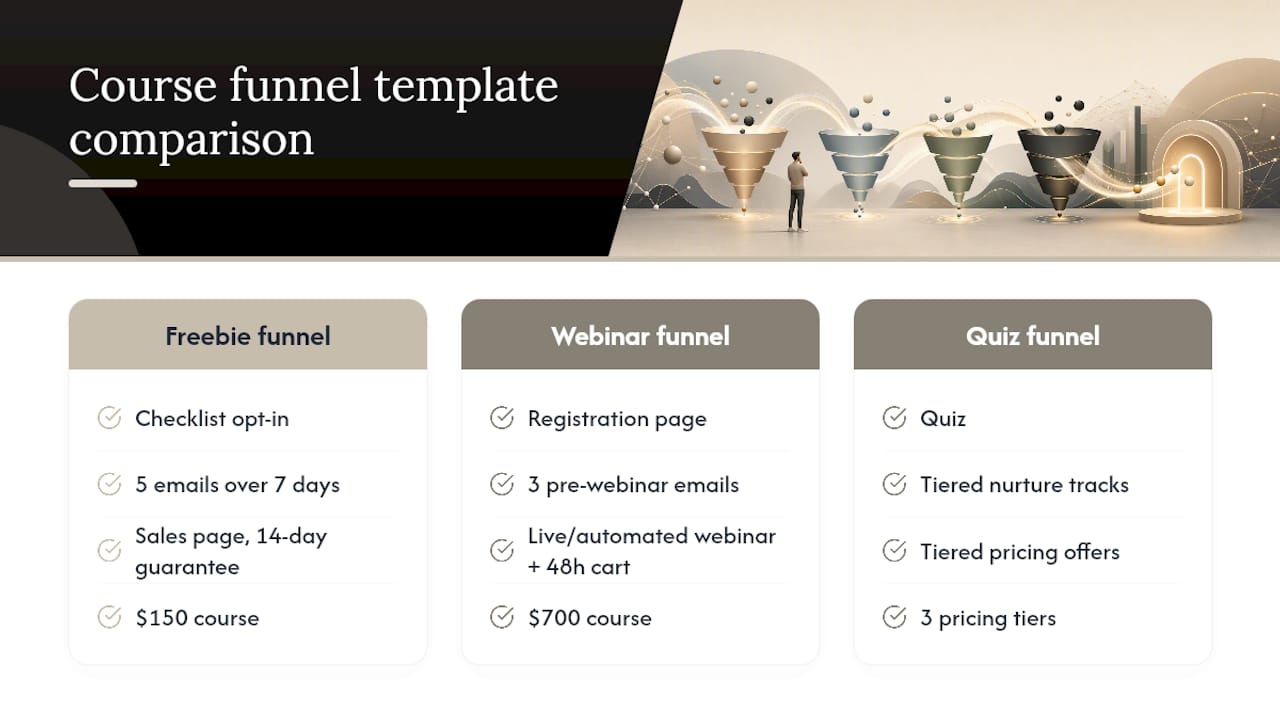
A freebie-to-nurture funnel for a $150 course typically runs: a one-page checklist opt-in, a five-email sequence over seven days mixing one teaching email, two proof emails, and two offer emails, ending on a sales page with a 14-day guarantee. This template works because the price point is low enough that buyers don't need extensive live interaction to feel confident.
A webinar funnel for a $700 course usually runs: a registration page promising one specific transformation, a three-email pre-webinar sequence to boost show rate, the live or automated webinar itself carrying most of the persuasion work, and a 48-hour cart window with one scarcity email on the final day. The price point justifies the extra production effort because the webinar format lets buyers see the teaching style before committing real money.
A quiz funnel for a course with three pricing tiers routes quiz-takers into one of three nurture tracks based on their result, each track referencing the specific tier that fits their stated need. This template earns its complexity only when the tiers genuinely differ enough to justify separate messaging.
Reviewing a handful of real landing page examples side by side makes the pattern obvious: the highest-converting versions all lead with a specific outcome in the headline, never a vague promise, and never more than one call to action per page.
A Course Creator's Practical Take: Three Mistakes to Fix First
Most creators optimize traffic before fixing checkout, which is backward. Fix the leak closest to revenue first: checkout friction and weak proof cost more enrollments than a mediocre ad ever will. Second, ditch the generic weekly newsletter in favor of short, segmented sequences tied to how someone entered your funnel. Third, pick one template, webinar, freebie, or quiz, run it for a full cycle, and improve it before building a second funnel. Chasing five templates at once means none of them get the attention that makes any of them work.
— Anastasia
How Aria Fits Into Your Funnel Without the Extra Subscriptions
Everything covered here, the opt-in page, the nurture emails, the checkout with a payment plan, the community for retention, usually means stitching together four or five separate tools and hoping the integrations hold. Some platforms run all of it from one interface: landing pages, email and SMS automation, checkout with order bumps and payment plans, and the community features that carry your retain stage, without a patchwork of connectors quietly breaking behind the scenes.
A practical starting sequence: publish your lead magnet on a landing page, connect a welcome and nurture sequence to it, then add a checkout page with a payment plan option before you send a single visitor to it. That order matters more than most creators realize, since a funnel with no checkout tested is a funnel that hasn't actually been built yet. Aria's platform overview walks through how the pieces connect for creators running courses and communities side by side. If you're ready to see the funnel builder, email automation, and checkout in one place, start with Aria and build your first opt-in page today.
Sources
For deeper stage-by-stage detail, the sales funnel stages breakdown covers when to use four stages instead of five. For checkout and payment plan mechanics, review the staged funnel model cited throughout this guide, and for retention tactics after the sale, see the membership retention strategies guide.
- Build an automated sales funnel for course sales
- Course Sales Funnel: 10 Best Steps to Convert in 2026
- How to sell online courses in 2026: 9 steps from idea to revenue
- Online Course Marketing: Complete Guide 2026
FAQ
What Are the 5 Stages of a Sales Funnel?
The five stages are attract, engage, nurture (or decision), convert, and retain, each with its own metric: opt-in rate, delivery engagement, email response, checkout completion, and lifetime value.
Is a Sales Funnel Still Relevant for Course Creators Today?
Yes. Structured funnels remain one of the most reliable ways to turn cold traffic into paying students, especially since checkout and offer clarity still decide most course sales more than traffic volume does.
Can You Actually Make Money Selling Online Courses?
Yes, course creators regularly generate revenue through structured funnels, particularly when they combine a strong lead magnet with a tested checkout and at least one upsell or order bump, which can meaningfully raise average order value.
What's a Good Way to Learn Funnel Building as a Creator?
Platform help guides like Kajabi's automated funnel walkthrough and broader marketing programs such as HubSpot Academy's digital marketing course both cover the traffic, email, and conversion mechanics this guide builds on.
Should I Start With a Webinar Funnel or a Freebie Funnel?
Choose a webinar funnel for courses priced above roughly $500, since live or automated presentations handle objections better at higher price points, and a freebie-to-nurture funnel for lower-ticket courses where a shorter sales cycle fits better.