
The fastest way to sell digital products is to validate one narrow product with a small audience test, host it on a checkout that keeps you owning the customer relationship, and launch with a single-step marketing funnel instead of a sprawling campaign. Skip the twelve-tool setup. Skip the perfect course curriculum. Pick one thing, get one payment, learn from it.
Here's your checklist to get moving today:
- Validate first. Post the offer to your existing audience (email, social, or a small forum) before you build anything, and gauge real interest rather than polite likes.
- Pick your route. Decide between your own store, a merchant-of-record platform, or a marketplace based on whether you already have an audience.
- Set an honest launch price. Price low enough to move fast and gather proof, high enough to respect your time.
- Publish the minimum viable version. A PDF, a five-video course, or a template pack counts. Perfection can wait for version two.
- Promote through one channel first. Email or a single platform where your audience already lives beats a scattered multi-channel push.
Where does an all-in-one platform like Aria fit into this? It covers the checkout, hosting, delivery, and audience tools in one login, which matters most once you move past your first sale and start managing pricing tiers, memberships, or a course catalog.
Key Takeaways
Selling digital products profitably comes down to validating demand first, pricing to outcome rather than effort, and consolidating your sales tools to protect your margin as you scale.
| Point | Details |
|---|---|
| Validate before building | Test demand with your existing audience before investing time in a full product. |
| Price for proof, then raise it | Launch at an honest promotional price to gather reviews, then increase toward true value. |
| Match platform to audience size | Use a marketplace with no audience, an owned store once you have one, to protect margin. |
| Confirm licensing and tax obligations | Check resale rights on any third-party assets and consult a local accountant as revenue grows. |
| Consolidate your tools | Aria combines checkout, courses, community, and automation into one dashboard to cut subscription costs and fragmented data. |
Table of Contents
- Why Sell Digital Products Online in the First Place
- Types of Digital Products That Actually Sell
- Where to Sell: Owned Store, Marketplace, or Merchant-of-Record?
- The Seven-Step Launch Checklist for Your First Digital Product
- Pricing and Packaging That Scale Beyond Your First Sale
- How to Deliver and Protect Your Digital Files
- Marketing Tactics That Actually Move Digital Product Sales
- What to Look For in a Digital Product Sales Platform
- Common Pitfalls, Taxes, and Copyright Basics
- The Market Case for Selling Digital Products Now
- What Consolidating Your Tools Actually Does to Your Margins
- Start Selling With One Platform Instead of Five Subscriptions
- Frequently Asked Questions
- Sources
Why Sell Digital Products Online in the First Place
The honest pitch for selling digital products online comes down to one number: your marginal cost per additional sale is close to zero. Once a course, template, or ebook exists, selling it to the next customer costs you almost nothing beyond payment processing fees and file storage. That's a fundamentally different economic engine than physical retail, where every unit sold means another unit made, packed, and shipped.
That economic shape changes what "success" looks like day to day.
- You get paid for the work once, then again, and again, without redoing the work.
- Revenue can compound instead of trading time for money hour by hour.
- A course or membership built around your expertise turns audience trust into recurring income.
- Products with near-zero reproduction cost make bundling and subscription packaging genuinely profitable rather than just a marketing gimmick.
Set your expectations correctly, though. The upfront work is real: recording a course, writing an ebook, or designing a template system takes concentrated hours before you see a dollar. What shrinks over time is the ongoing maintenance. A well-made template needs occasional updates. A course needs a refresh every year or two, not a rebuild every month.
Statistic Callout: Market tracking from Statista's online-education outlook shows continued worldwide growth in digital learning and content consumption, a signal that demand for knowledge-based digital products isn't slowing down.
The timeline for a first sale usually runs two to six weeks for a focused creator: one week to validate, one to two weeks to build a minimum viable version, and the rest to set up the sales page and run a small launch. That's a realistic range, not a guarantee, and it depends heavily on how warm your existing audience is.
Types of Digital Products That Actually Sell
Not every digital product idea deserves your time. Some formats have a much shorter path from idea to first sale than others, and matching the format to your actual skills and time budget matters more than chasing whatever's trending.
- Mini-courses. Best for creators with teaching experience or a clear process to share. Typical price: $27 to $197. Time-to-MVP: one to three weeks for a five-to-ten lesson course.
- Templates and swipe files. Best for designers, marketers, or anyone with a repeatable workflow. Typical price: a moderate price range. Time-to-MVP: days, not weeks.
- Ebooks and guides. Best for writers with existing content to compile or a niche topic they know cold. Typical price: a moderate price range. Time-to-MVP: one to two weeks.
- Presets and filters. Best for photographers and video editors with a distinct visual style. Typical price: a moderate price range. Time-to-MVP: a few days.
- Audio products (sample packs, meditations, sound libraries). Best for musicians and audio producers. Typical price: a moderate price range.
- Software and plug-ins. Best for developers solving a specific, narrow workflow problem. Typical price: a moderate to higher price range, often subscription-based.
- Memberships and communities. Best for creators with an engaged, ongoing audience who want recurring revenue over one-off sales. Typical price: a moderate monthly subscription price range.
Pro Tip: If you're not sure where to start, build a checklist, template, or preset pack first. These take the least time to produce, let you test pricing and messaging fast, and give you real sales data before you invest weeks into a full course.
Where to Sell: Owned Store, Marketplace, or Merchant-of-Record?
Choosing where to sell digital products online matters as much as choosing what to sell. There are three practical routes, and each one trades convenience for control in a different way.
An owned store is a website or storefront you control directly, where you own the checkout, the customer data, and the branding. A merchant-of-record platform processes the payment on your behalf and often handles sales tax and VAT remittance for you, in exchange for a bigger cut of each sale. A marketplace puts your product in front of built-in shopper traffic you didn't have to build yourself, but takes a larger effective fee and gives you far less control over the customer relationship. This general framing of the three routes and their trade-offs holds regardless of which specific tools you use.
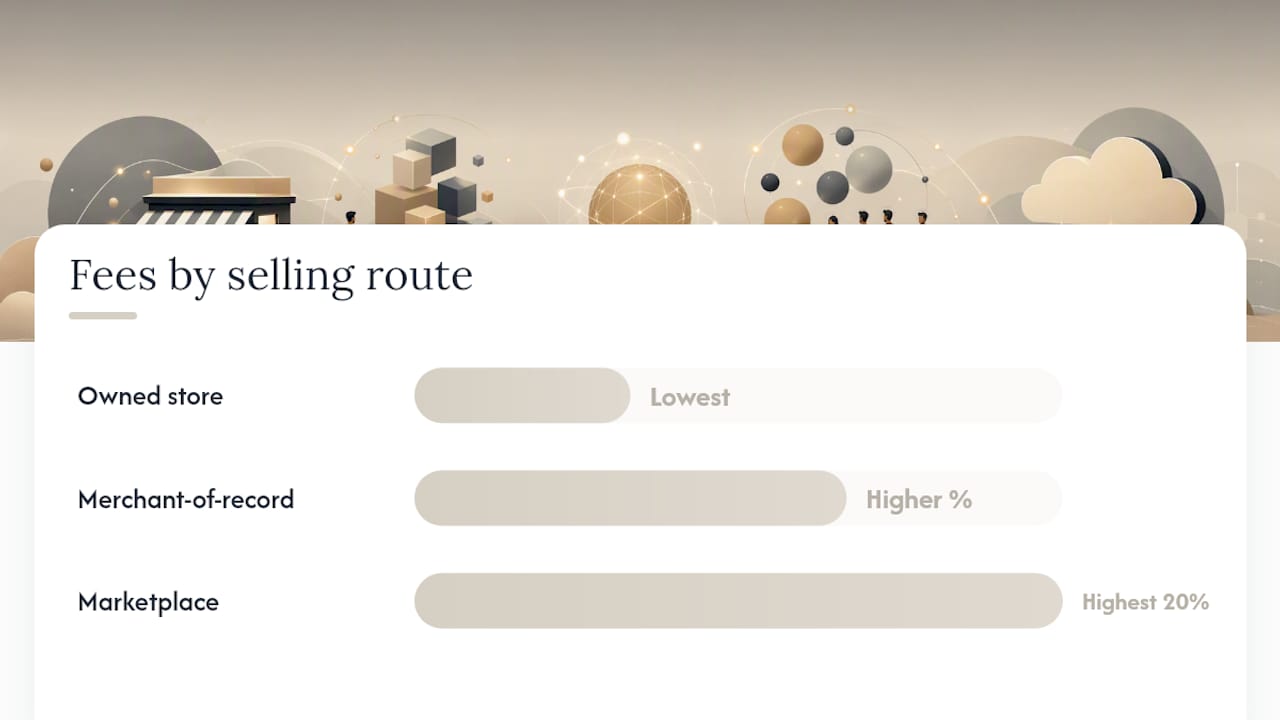
| Route | Fees | Customer ownership | Tax handling | Traffic |
|---|---|---|---|---|
| Owned store | Lowest, usually a flat processing fee | You keep full customer data and email list | You manage tax registration and remittance yourself | You must generate your own traffic |
| Merchant-of-record | Higher percentage per sale | Partial, platform sits between you and buyer | Platform handles VAT/sales tax on your behalf | Depends on your own marketing |
| Marketplace | Highest effective cut, sometimes 20 percent | Marketplace owns the customer relationship | Marketplace typically handles tax compliance | Built-in browsing traffic |
If you already have an audience, an owned store keeps the most margin in your pocket and lets you build a direct email relationship with every buyer. If you're starting from zero audience, a marketplace can bootstrap your first sales using traffic you didn't have to build, with the plan to migrate toward your own store once you have proof of demand and a small following.
The Seven-Step Launch Checklist for Your First Digital Product
Getting from idea to first sale is a sequence, not a single leap. Here's the order that actually works, drawn from patterns across creators who've done this successfully.
- Validate the idea. Post the concept to your audience, run a poll, or ask for a small deposit before building. Validating demand before you build is the single biggest predictor of whether a first digital product succeeds or flops.
- Build the minimum viable version. Ship the smallest version that solves the core problem. Five lessons, not fifteen. A twelve-page template, not a fifty-page manual.
- Set your price. Start with a promotional launch price, not your final price. You're buying early reviews and testimonials, not maximizing day-one revenue.
- Set up your platform. Choose your checkout, connect payment processing, and configure automatic file delivery or course access.
- Build the product page and checkout. Keep the checkout to one click wherever possible. A clean product page and fast checkout is consistently the difference between a browser and a buyer.
- Launch with outreach. Email your list, post to the one platform where your audience is most active, and ask a few early customers for feedback publicly.
- Measure and iterate. Track conversion rate, refund rate, and where buyers drop off, then adjust the offer or the price accordingly.
A realistic week-by-week timeline for your first launch:
- Week 1: Validate with your audience, gather commitments or pre-orders.
- Week 2: Build the MVP version of the product.
- Week 3: Set up checkout, product page, and delivery system.
- Week 4: Launch, promote through one channel, and collect first feedback.
Pricing and Packaging That Scale Beyond Your First Sale
Price to the outcome your product delivers, not to how many hours it took you to make it. A template that saves a marketer ten hours a month is worth more than its production time suggests, and pricing it based on your effort instead of the buyer's outcome leaves real money on the table.
Four packaging models cover most successful digital product businesses:
- One-off sale. Simple, easy to sell, but revenue stops unless you keep finding new buyers.
- Subscription or membership. Recurring revenue from ongoing access, updates, or community.
- Tiered access. A basic version at a lower price, a premium version with more support or content at a higher one.
- Bundles and order bumps. Grouping related products together, or offering a related item at checkout, raises the average order value without adding new marketing cost.
Statistic Callout: Salesforce's guidance on digital product sales points out that bundling and subscription packaging frequently increase average order value and customer lifetime value compared with single one-off sales, because the marginal cost of adding a second or third item to a bundle is close to nothing.
A simple pricing rule of thumb: launch at a price that's slightly below what you believe the long-term value supports, gather five to ten reviews, then raise the price. This approach lets you collect proof before committing to your final number, rather than guessing at launch and either scaring off early buyers or leaving revenue on the table permanently.
How to Deliver and Protect Your Digital Files
Selling digital downloads means solving a problem physical retailers never face: once a file is out, it can be copied and shared infinitely unless you build in some friction. The goal isn't to lock things down so hard that paying customers get frustrated. It's to make casual sharing inconvenient without punishing legitimate buyers.
- Automatic delivery. Set up gated downloads that unlock immediately after payment, so buyers never wait on you to send a file manually.
- Expiring links. Generate download links that expire after a set number of uses or days, reducing casual link sharing.
- License keys. For software or plug-ins, issue unique license keys tied to each purchase so you can track and revoke access if needed.
- User accounts. Require buyers to create an account to access their purchase, which also gives you a channel for future offers.
- Secure file hosting. Store files with hashed filenames in a private storage bucket behind a CDN, rather than a publicly guessable URL.
- Role-based access for memberships. Course and membership platforms should let you control who sees what content and revoke access automatically when a subscription lapses.
Pro Tip: Don't over-engineer security for a $15 template. Heavy DRM and account walls make sense for a $500 software license, not a checklist PDF. Match the friction to the price point, or you'll lose more sales to frustration than you'll save from piracy.
Marketing Tactics That Actually Move Digital Product Sales
Most creators overthink marketing and underthink sequencing. A handful of tactics reliably outperform the rest, especially for a first launch with limited time and budget.
- Email launch sequence. A three-email sequence (announcement, social proof, last-chance) to your existing list typically outperforms any paid ad in the first thirty days.
- Content built around search intent. Blog posts or videos answering the exact questions your buyers are typing into search bars build compounding organic traffic over months.
- Partnerships and affiliates. A single well-matched partner promoting your product to their audience can outperform weeks of solo marketing.
- Micro-ads. Small, targeted ad spends ($5 to $20 a day) testing one audience segment at a time, rather than a large untested budget upfront.
- Referral incentives. Give existing customers a reason to share, whether that's a discount, bonus content, or a simple affiliate commission.
A simple campaign to copy: send email one announcing the product and the problem it solves, email two sharing an early testimonial or use case, and email three with a deadline and a modest discount for people who haven't bought yet. Pair that sequence with one piece of content (a blog post or short video) published the same week, and offer a 20 to 30 percent affiliate commission to two or three partners with adjacent audiences.
If your audience is small, lean almost entirely on organic tactics: email, content, and partnerships. Once you have proof that the product converts, layer in paid micro-ads to accelerate what's already working rather than using ads to discover what works. Building genuine audience relationships through a community tends to outperform cold traffic for digital product sales specifically, because buyers already trust you before they see the price.
What to Look For in a Digital Product Sales Platform
Choosing a digital product sales platform comes down to seven criteria that directly affect your revenue, compliance, and how much time you spend on maintenance instead of growth.
- Checkout conversion. A one-click or one-page checkout converts noticeably better than a multi-step process.
- Customer ownership. Does the platform give you the buyer's email and contact details, or does it keep that relationship?
- Tax handling. Does the platform remit VAT and sales tax on your behalf, or are you responsible for registration and filing?
- File delivery and security. Built-in gated downloads, license keys, and expiring links save you from stitching together separate tools.
- Membership and access controls. Role-based access that automatically updates when someone subscribes or cancels.
- Analytics. Clear visibility into conversion rate, refund rate, and traffic source without needing a separate analytics subscription.
- Automation. Email sequences, abandoned cart follow-ups, and workflow triggers that run without manual work.
Each of these affects a different part of your business. Checkout conversion affects revenue directly. Tax handling affects compliance risk. Customer ownership affects your ability to market to the same buyer again without paying to reacquire their attention.
This is where an all-in-one platform earns its keep. Aria combines the checkout, course hosting, membership management, community tools, and automated email sequences into a single interface, so a creator managing pricing tiers, a membership tier, and a course catalog isn't logging into five separate tools to keep it all running. That consolidation directly answers the checklist above: branding control comes from owning your storefront, community and course features live in the same dashboard as your sales data, and automations handle the repetitive marketing tasks that eat a solo creator's week. You can see the fuller feature breakdown on Aria's platform page.
Pro Tip: If you're migrating from a marketplace to your own store, do it gradually. Keep your marketplace listing live while you build your email list and owned store audience, then shift new customers toward your own checkout once you have enough direct traffic to not depend on the marketplace's built-in browsers.
Common Pitfalls, Taxes, and Copyright Basics
The mistakes that sink digital product businesses are rarely dramatic. They're small, avoidable decisions made early and never revisited.
- Skipping validation. Building a full course before confirming anyone wants it is the most common and most expensive mistake.
- Underpricing permanently. A promotional launch price is a tactic, not a permanent strategy. Raise it once you have proof.
- No refund policy. An unclear or absent refund policy creates support headaches and chargeback risk later.
- Weak access controls. Selling a membership without role-based access controls means former subscribers keep access after canceling.
On taxes, the core distinction is simple: some platforms act as a merchant-of-record and handle VAT and sales tax remittance on your behalf, usually for a higher transaction fee. Others leave tax registration and filing entirely to you, which keeps more revenue in your pocket but adds real compliance work as you sell across different countries and states.
Copyright and licensing deserve equally plain treatment. If you're selling templates, presets, or software, be explicit about what buyers can and can't do with the file, whether they can resell it, modify it, or use it commercially. If your product includes any third-party assets, fonts, stock photography, sample packs, confirm you have a license that covers commercial resale before you publish. Review a platform's acceptable use policy before listing anything that touches gray areas like resale rights or user-generated content.
This guide offers general information, not professional tax or legal advice. Confirm your specific obligations with a qualified accountant or attorney in your own country as your revenue grows.
The Market Case for Selling Digital Products Now
Digital product demand isn't a passing trend tied to one platform or one year. It reflects a structural shift in how people learn, work, and buy expertise.
- Worldwide, digital learning and content consumption continue growing, based on Statista's online-education outlook, which suggests sustained demand for knowledge products like courses, guides, and templates.
- Near-zero marginal cost per sale means a creator's income can scale without a proportional increase in hours worked, unlike service-based businesses.
- Low starting costs mean the main barrier to entry for most creators is time and validation, not capital.
Statistic Callout: Many creators launch with free or low-cost tools and pay only transaction fees until revenue justifies a paid platform upgrade, which means the primary cost of starting a digital product business is your own time, not startup capital.
Put together, this points to an opportunity that rewards creators who move deliberately: validate small, price honestly, and scale packaging once proof exists, rather than waiting for a perfect product or a bigger audience before starting.
What Consolidating Your Tools Actually Does to Your Margins
Most creators don't realize how much of their monthly revenue quietly disappears into separate subscriptions until they add it up. A course host here, an email tool there, a separate community platform, a scheduling app, a checkout processor. Each one is reasonable on its own. Together, they add up to real money and real time lost logging in and out of five dashboards to answer one question: is this working?

The bigger cost isn't even the subscription fees. It's the fragmented data. When your course sales, email opens, and community engagement all live in different tools, you can't easily see which marketing effort actually drove a sale. You end up guessing at what's working instead of knowing, because the analytics that would answer that question are split across systems that don't talk to each other.
Consolidating those functions into a single platform changes the daily experience more than most creators expect. One login instead of five. One analytics view instead of piecing together screenshots from different dashboards. One place to launch an email sequence, watch it convert, and adjust the offer, all without exporting a spreadsheet first.
If you're currently juggling more than three separate subscriptions to run your digital product business, it's worth calculating what consolidation would save you, both in dollars and in the hours you spend context switching between tools that were never built to work together.
Start Selling With One Platform Instead of Five Subscriptions
Aria replaces the checkout tool, course host, email platform, and community app you'd otherwise stitch together, which means you set up pricing, delivery, and marketing automations in one dashboard instead of five separate logins.
Every feature on the buying checklist above maps directly to something Aria already handles: a branded checkout you control, course and membership hosting with role-based access, a community space to build the trust that drives repeat sales, and automated email sequences that run your launch campaign without manual follow-up. Analytics live in the same view as your sales data, so you can see what's converting without exporting anything.
Getting started follows the same seven-step checklist covered earlier. Sign up, build your first product page, connect your checkout, and publish. From there, your launch emails and community posts run from the same platform where your product lives, which cuts out the friction of switching tools mid-launch. If you're ready to move from idea to first sale without assembling a stack of separate subscriptions, start with Aria's platform overview to see how the setup works for your specific product type.
Frequently Asked Questions
Is selling digital products actually profitable? It can be, largely because of the near-zero marginal cost per additional sale. Profitability depends more on getting pricing and validation right than on the product category itself.
What's the easiest digital product to start with? Templates, checklists, and presets tend to have the fastest time-to-MVP, often just days, which makes them ideal for testing your first offer before investing in a full course.
Where should I sell digital products if I have no audience yet? A marketplace gives you built-in traffic to bootstrap your first sales, with a plan to migrate toward your own store once you've built some following and proof of demand.
How do I price my first digital product? Launch at a promotional, honest price to gather early reviews and testimonials, then raise the price once you have social proof supporting the value.
Do I need a separate platform for courses, memberships, and digital downloads? No. An all-in-one platform like Aria handles course hosting, membership access, and digital product checkout in a single dashboard, which reduces both cost and the operational complexity of running separate tools.
Sources
- How to Sell Digital Products: your Guide to Getting Started | Salesforce
- Sell Digital Products Online: The Complete 2026 Guide
- Statista — Online education worldwide outlook