
Lead scoring is a numeric system that ranks prospects by fit and buying intent, usually on a 0 to 100 scale, so sales and marketing agree on who gets called first. The point is simple: stop treating every form fill the same way. A properly built model pairs that score with a letter grade (A through D) for fit, and together they tell your team exactly where to spend the next hour.
TL;DR:
- Lead scoring should separate fit attributes from engagement signals to accurately identify who is a good match and who is actively buying.
- For teams with fewer than 200 leads monthly, a rules-based approach using clear fit and behavior criteria is more effective than predictive models.
- Assign point values based on uplift over the baseline conversion rate, and set thresholds to trigger different sales actions, from nurturing to direct outreach.
- Regularly test and recalibrate the scoring model by analyzing key KPIs such as conversion rates, time-to-contact, and sales acceptance to prevent drift.
- Using an integrated platform like Aria can streamline data capture, scoring, and routing, reducing delays and improving lead qualification speed.
Table of Contents
- What Lead Scoring Basics Actually Measure: Fit vs. Engagement
- Which Lead Scoring Model Fits Your Team's Stage?
- How Do You Build Your First Lead Scoring Model?
- How Do You Test and Calibrate a Lead Scoring Model?
- What Data and Tools Does Reliable Lead Scoring Require?
- Sample Scoring Rules You Can Test This Week
- How Aria Supports the Scoring Workflow Described Here
- When Should You Stay Simple vs. Invest in Predictive Scoring?
- Put Lead Scoring on Autopilot With Aria
- Sources
- FAQ
What Lead Scoring Basics Actually Measure: Fit vs. Engagement
Every reliable model tracks two different questions, and conflating them is where most scoring systems break. The first question is: does this person or company match who we sell to? The second is: are they actually behaving like a buyer right now? Keeping those two separate is the single most important idea in understanding lead scoring.
Fit signals are explicit. They come from a form, a CRM field, or a data enrichment tool, and they rarely change week to week. Common fit fields include:
- Job title or seniority (VP, director, individual contributor)
- Company size or employee count
- Industry or vertical
- Annual revenue or funding stage
- Geographic region (relevant for territory-based sales teams)
Engagement signals, sometimes called intent signals, are implicit. They come from what a lead does, not what they claim to be. Priority actions worth tracking:
- Visiting the pricing page
- Requesting a demo or free trial
- Opening or clicking multiple emails in a short window
- Returning to the site after a gap of inactivity
- Attending a webinar or downloading a comparison guide
Here is why the separation matters operationally. A marketing intern at a Fortune 500 company might click every email you send, rack up a huge engagement score, and still be a terrible fit because they have zero purchasing authority. Meanwhile, a VP at a company that matches your ideal customer profile perfectly might visit your site once a month and never open an email, yet represent your best possible account. Blend both signals into one number and you will bury that VP under a stack of enthusiastic interns.
This is why lead grading exists as a companion to numeric scoring rather than a replacement for it. Grading assigns a letter, typically A through D, based purely on fit criteria. Scoring assigns a number based purely on behavior. A lead graded "A" with a score of 15 is a strategic account that hasn't engaged yet, worth a manual outreach. A lead graded "D" with a score of 90 is someone clicking everything but unlikely to ever buy. Neither number alone tells you what to do. Together, they do.
Which Lead Scoring Model Fits Your Team's Stage?
There's no single "best" model, only the right one for your data maturity and sales volume. Choosing wrong in either direction wastes months.
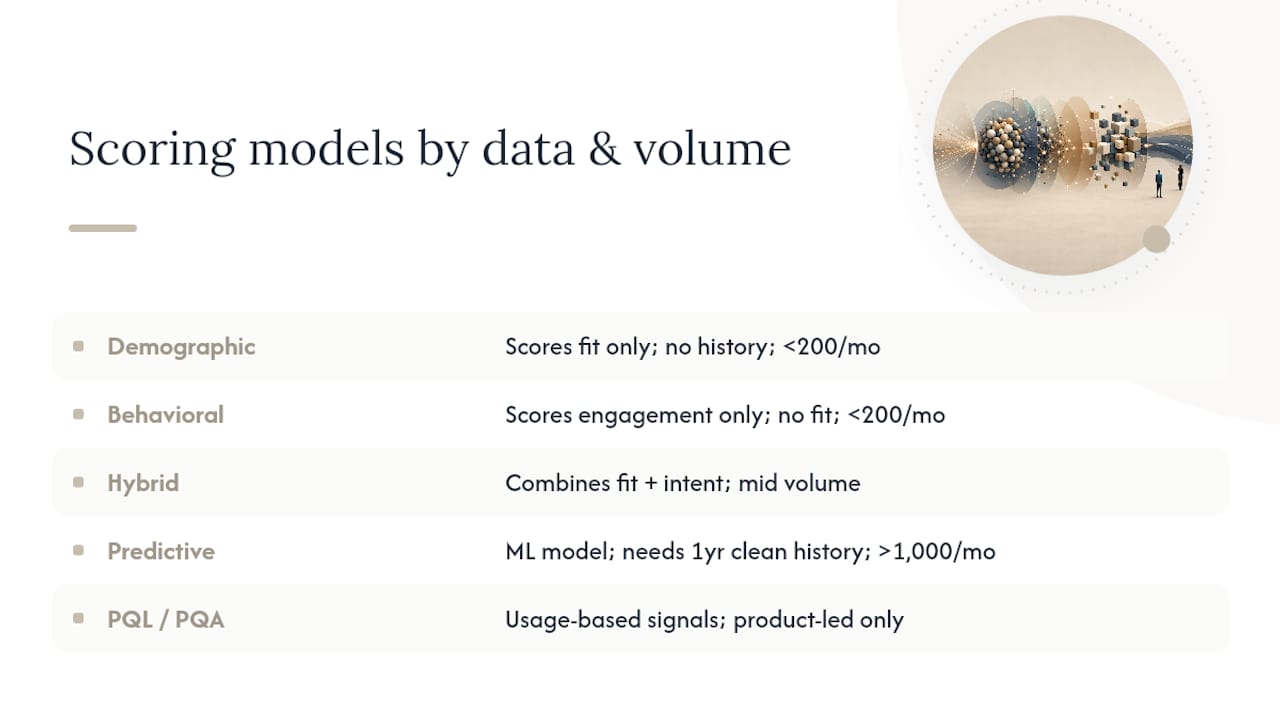
Demographic and firmographic models score fit alone. They're the simplest to build, require no historical data, and work fine for teams with fewer than a few hundred leads a month. The trade-off is obvious: they say nothing about timing, so a perfect-fit lead who isn't ready to buy scores the same as one about to sign a contract.
Behavioral models score engagement alone, tracking clicks, visits, and content downloads. They catch buying signals fast but can't tell you if the engaged lead is even someone you'd want as a customer.
Hybrid models combine both, usually as a 2x2 matrix or a weighted formula. Most B2B companies land here once they have enough volume to justify the setup work, because it directly addresses what Clearbit's lead scoring framework calls the gatekeeper problem: fit should gate who sales prioritizes, while intent decides when they act.
Predictive models use machine learning to find patterns across dozens of variables that a human would never manually weight correctly. They can outperform rules-based systems at scale, but they need months of clean, historical closed-won and closed-lost data to train on. A team without that history that jumps straight to predictive scoring is training a model on noise. The research on lead scoring's impact on sales performance is consistent on this point: start with rules, graduate to prediction once you have the data to support it.
PQLs and PQAs (product-qualified leads and accounts) apply to product-led businesses where usage inside a free trial or freemium product, not a form fill, signals intent. A PQL rule might trigger when a trial account invites three teammates and connects a payment method. That behavior predicts conversion far better than a webinar registration ever could.
Pro Tip: If you're not sure which model to start with, count your monthly lead volume. Under 200 a month, build rules-based fit and behavior scoring by hand. Over 1,000 a month with at least a year of clean CRM history, a predictive vendor becomes worth evaluating.
How Do You Build Your First Lead Scoring Model?
Building a first model is mechanical work, not guesswork, if you follow the calculation in order. Skipping the baseline step is the most common reason new models produce numbers nobody trusts.
- Calculate your baseline conversion rate. Pull every lead from the last 6 to 12 months in your CRM and divide customers won by total leads. If 40 out of 1,000 leads became customers, your baseline is 4%. Every point value you assign later gets measured against this number.
- List candidate attributes. Separately list fit attributes (title, company size, industry) and engagement attributes (pricing page visit, demo request, email clicks). Include negative signals too: personal email domains, competitor employees, or explicit unsubscribes.
- Calculate the close rate for each attribute. For leads who visited the pricing page, what percentage became customers? If pricing-page visitors convert at 12% against a 4% baseline, that's a 3x uplift, a strong signal worth real points. According to HubSpot's lead scoring methodology, this uplift-versus-baseline math is exactly how initial point values should be assigned rather than guessed.
- Assign point values proportionate to uplift. A 3x uplift attribute might earn 15 to 20 points. A 1.2x uplift attribute might earn 3 to 5 points. Negative attributes subtract points, sometimes enough to disqualify a lead outright.
- Choose your scale and set thresholds. Most teams use 0 to 100. Decide where marketing-qualified (MQL) and sales-qualified (SQL) thresholds sit, for example MQL at 40 and SQL at 70.
- Define routing rules and SLAs. Once a lead crosses the SQL threshold, who gets notified, and how fast must they respond? A first-touch response inside 5 minutes correlates strongly with higher contact rates than waiting even an hour, which is why fast routing rules matter as much as the score itself.
- Implement in your CRM or automation platform. Build the scoring logic as a workflow that updates automatically on new data, not a spreadsheet someone updates manually once a week.
- Track first-touch response time from day one. This becomes your earliest signal that routing, not just scoring, needs adjustment.
A few practical notes as you work through that list:
- Don't assign point values from intuition alone. Even a rough baseline calculation beats a guess.
- Keep the number of scored attributes small at first. Ten well-chosen attributes outperform thirty noisy ones.
- Build negative scoring in from day one rather than bolting it on later; retrofitting disqualification rules onto a live model is harder than it sounds.
- Document why each attribute earned its point value. Six months from now, nobody will remember the logic otherwise.
Tools like a shared CRM view or a structured landing page that captures the right fit fields up front make step 2 dramatically easier, because you're not retrofitting form fields after the fact.
How Do You Test and Calibrate a Lead Scoring Model?
A model you never revisit will drift. Buyer behavior changes, your product changes, and a scoring rule that made sense a year ago quietly stops predicting anything.
Four KPIs matter more than the rest:
- MQL to SQL conversion rate. If marketing-qualified leads rarely become sales-qualified, your MQL threshold is set too low.
- Lead-to-customer conversion by score band. Leads scoring 80 to 100 should convert at a meaningfully higher rate than leads scoring 40 to 59. If they don't, your point values need rework.
- Time-to-contact. How fast does sales actually respond once a lead crosses threshold?
- Sales-accepted rate. What percentage of leads sales agrees are worth working, versus rejects as poor fit?
Validate the model before trusting it fully. Backtest your point system against last year's closed-won and closed-lost leads to see if it would have correctly prioritized the deals that actually closed. Where possible, run a routing A/B test: send half your qualified leads through the new scoring model and half through the old process, then compare conversion after 60 days.
One data point worth building your calibration case around: Smartsheet saw an 84% increase in marketing-qualified leads after connecting scoring to verified data and recalibrating thresholds. That kind of jump doesn't come from a smarter formula. It comes from cleaning the inputs the formula runs on.
Run your initial test for several weeks before making major changes. This period allows observing conversion patterns across a full sales cycle for most B2B products. After that, review quarterly rather than constantly, since scores need stability to be trusted by the sales team using them.
Watch for these recurring pitfalls:
- Stale data. A lead scored six months ago based on a title they no longer hold is scoring a ghost.
- The cancellation effect. A high-fit account with low activity and a low-fit lead with high activity can cancel out into an identical middling score, hiding both from the people who should see them.
- Over-weighting easy signals. Email opens are easy to track and tempting to over-score, but they predict far less than a pricing page visit or demo request.
- Missing negative rules. Without penalty scoring, a competitor's employee researching you for a case study can outscore your actual prospects.
What Data and Tools Does Reliable Lead Scoring Require?
Scoring is only as good as what feeds it. Before assigning a single point value, get the tracking right.
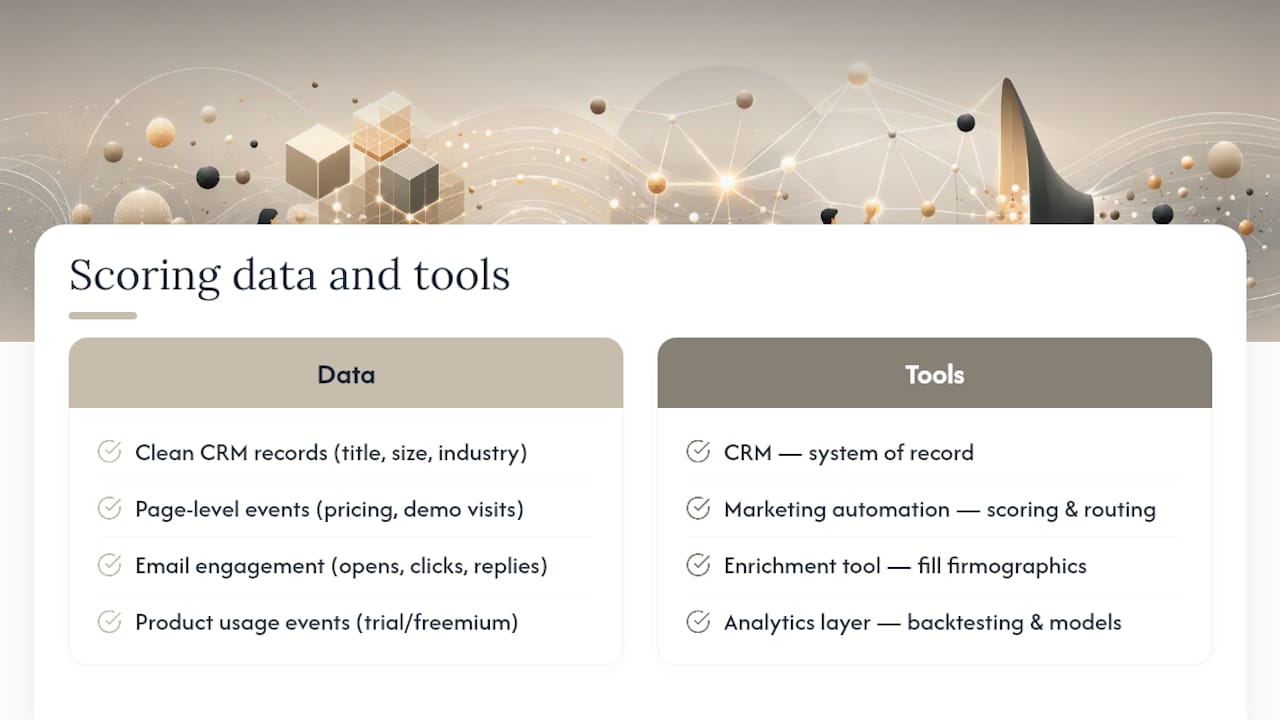
At minimum, you need clean CRM records (accurate titles, company size, industry), page-level event tracking (who visited pricing, who visited the demo page), email engagement data (opens, clicks, and ideally reply rates), and product usage events if you sell anything with a trial or freemium tier.
On tooling, most teams need four pieces working together: a CRM as the system of record, marketing automation to trigger scoring updates and route qualified leads, an enrichment tool to fill in missing firmographic fields, and an analytics layer to run the backtesting described above. A CRM and email integration setup that syncs in near real time prevents the single most common scoring failure: a lead who took a high-intent action three days ago but whose score hasn't updated because two systems are out of sync.
Add a predictive vendor only once you have at least six months, ideally a year, of clean closed-won and closed-lost history to train against.
Governance matters as much as the tools themselves. Pick one system as the single source of truth for the score, define how often data syncs between platforms, and assign one team, usually marketing operations, as the owner who resolves disputes when sales and marketing disagree on a threshold. If your leads span multiple countries, be mindful that data collection and enrichment practices carry different privacy obligations depending on where a contact is located, so consent and storage rules should match the region a lead comes from.
Sample Scoring Rules You Can Test This Week
A working model doesn't need to be complex to start. Here's a sample point structure many B2B teams use as a first draft:
- Requested a demo: +20 points
- Visited the pricing page: +15 points
- Job title includes "Director" or above: +15 points
- Company size between 50 and 500 employees: +10 points
- Opened 3 or more emails in 30 days: +5 points
- Personal email domain (gmail.com, yahoo.com): −10 points
- Unsubscribed from email: automatic disqualification
Add those up and a director-level lead from a 200-person company who requested a demo and visited pricing lands at 60 points before engagement points even factor in.
Map bands to action rather than leaving scores sitting unused:
- 0 to 29: General nurture sequence, low-frequency content emails
- 30 to 59: Marketing nurture with more targeted content based on their fit grade
- 60 to 80: SDR outreach, personal email or call within a day
- 81 to 100: Direct sales demo request, immediate routing
A welcome sequence built for lower-scoring leads keeps them warm without consuming sales time they haven't earned yet.
For product-led businesses, a PQL rule might look like this: a trial user who invites two or more teammates and completes the core setup flow within their first 7 days triggers an automatic Slack alert to sales, regardless of any other score.
Pro Tip: Weight recency, not just frequency. A pricing page visit from yesterday should outscore three pricing page visits spread across the last six months. The sequence of actions also matters. Email click, then pricing visit, then demo request predicts a close far better than three isolated pricing visits with nothing in between.
How Aria Supports the Scoring Workflow Described Here
Every step in this guide, from capturing fit fields on a form to routing a qualified lead to sales, requires tools talking to each other. Aria combines the CRM, automation builder, and form and landing page features into one system, which removes the sync delays that cause scores to lag behind actual behavior.
A typical workflow inside Aria follows the same five stages this article walked through:
- Capture: A landing page or form collects fit fields (title, company size) at signup
- Enrich: Automation rules fill gaps and tag leads by source
- Score: Point values apply automatically as behavior events (page visits, email opens) roll in
- Route: Leads crossing your SQL threshold trigger an instant notification to the right team member
- Nurture: Everyone below threshold drops into an automated sequence until they earn another look
Because capture, scoring, and routing sit in one platform rather than multiple separate subscriptions, there is minimal delay between a lead crossing a threshold and someone finding out.
When Should You Stay Simple vs. Invest in Predictive Scoring?
If your team is scoring fewer than a few hundred leads a month, a rules-based model with clear fit and intent separation will outperform anything more complex, mostly because you can actually explain it to sales. Before considering predictive scoring, check three things: do you have a year of clean closed-won and closed-lost data, does your current model already show measurable lift over random assignment, and does sales trust the score enough to act on it without double-checking?
If any answer is no, instrument better first. Measure lift from your rules-based model for a full quarter before spending on machine learning you don't yet have the data to train properly.
— Anastasia
Put Lead Scoring on Autopilot With Aria
If you've been piecing together a form builder, a separate CRM, and a third automation tool just to run the workflow in this guide, you already know the real cost isn't the scoring formula. It's keeping three systems synced without dropping a lead in the gap between them. Aria replaces that stack with one platform where capture, scoring, and routing share the same data in real time, so a pricing page visit updates a score the moment it happens instead of overnight.
For teams building their first model, landing page and automation templates can handle steps 1 through 7 of the checklist above without custom development. You can also test acquisition-channel differences by pairing Aria's automations with a tool like AmmarAI's LinkedIn ad generator to see whether leads from sponsored content score and convert differently than organic form fills. Explore what Aria's all-in-one platform includes, or visit the Aria homepage to start building your first scoring workflow.
Sources
- Lead Scoring Explained: How to Identify and Prioritize High-Quality Prospects
- What Is Lead Scoring? A Complete Guide
- The state of lead scoring models and their impact on sales performance
FAQ
How Is a Lead Score Calculated?
A lead score is calculated by assigning point values to fit attributes (title, company size) and engagement attributes (pricing visits, demo requests), where each point value is set proportionate to how much that attribute lifts conversion above your baseline rate.
Can You Give an Example of Lead Scoring?
A director-level contact from a 200-person company who requests a demo (+20 points) and visits the pricing page (+15 points) plus their title match (+15 points) reaches 50 points before any email engagement is added, likely qualifying them for SDR outreach.
How Do You Do Lead Scoring From Scratch?
Start by calculating your baseline lead-to-customer conversion rate from CRM data, then assign points to fit and engagement attributes based on each one's close-rate uplift, set MQL and SQL thresholds, and implement the logic inside a CRM or automation platform like Aria.
What Is the 5 Minute Rule for Leads?
The 5 minute rule holds that contacting a lead within 5 minutes of a high-intent action, like a demo request, dramatically increases the odds of a live conversation and downstream conversion compared to waiting even an hour.