
Price your course by working backward from outcomes, not forward from your time invested. A rough map: mini offers land around $97 to $197, core courses at $297 to $997, premium or cohort programs at $997 and up. Launch the pilot, track conversion and feedback, then adjust.
TL;DR:
- A three-tier pricing ladder—basic, standard, and premium—helps buyers self-select and reduces choice paralysis while boosting overall revenue.
- Running a pilot course at a discounted rate and collecting feedback ensures your final price aligns with market demand and perceived value.
- Using pricing psychology tactics, like anchoring and scarcity, can protect your course’s perceived value and encourage higher conversion.
- Monitoring key metrics such as conversion rate, refunds, and lifetime value guides when to raise prices and how to structure future offerings.
Table of Contents
- Core Pricing Frameworks for a Defensible Course Pricing Strategy
- Choose the Pricing Model That Matches Your Course
- How Do You Build a 3-Tier Pricing Ladder?
- How Do You Test a Course Price Before Launch?
- Pricing Psychology Tactics That Protect Perceived Value
- Which Metrics Signal It's Time to Raise Your Price?
- Anastasia's Pricing Checklist for Course Creators
- Legal and Tax Considerations in Course Pricing
- How Do You Analyze Competitor Pricing and Positioning?
- Segmenting Your Audience to Tailor Course Prices
- Strategies for Bundling Courses and Upselling
- What This Looks Like in Practice
- How Aria Helps You Run Pricing Experiments and Tiered Launches
- Sources
- FAQ
Core Pricing Frameworks for a Defensible Course Pricing Strategy
Most creators price by guesswork, then wonder why sales stall. A better course pricing strategy starts with value, not with hours spent recording video.
Value-based pricing and the 10x rule ask a simple question: what is the outcome worth to the learner, and what would they pay elsewhere to get it? If your course helps a freelancer land one $3,000 client, a $297 price tag is a rounding error compared to the payoff. The 10x rule says your price should sit at roughly a tenth of the value delivered, which is why most creators underprice by half or more.
The PRICE framework breaks that value down into five factors that push your number up or down:
- Personalized support (office hours, feedback, coaching calls)
- Results you can point to (case studies, completion data, outcomes)
- Industry research (what buyers already pay for similar transformations)
- Course depth (hours of content, number of modules, complexity)
- Experience and credibility (your track record in the niche)
Score your course against each factor, then use cost-plus or competitor pricing as a sanity check, not the starting point.
Choose the Pricing Model That Matches Your Course
The right model depends on cash needs, delivery format, and how much hand-holding your content requires.
- One-time payment works best when you need cash now and your content is fully self-paced; it also converts better for lower-ticket courses.
- Subscription favors ongoing content libraries where lifetime value matters more than a single upfront sale.
- Cohort-based courses commonly command 2 to 3 times the price of self-paced versions, because live accountability drives real completion.
- Tiered pricing captures different buyer segments at once without building three separate products.
- Freemium or pay-what-you-want suits list-building or reputation launches, not revenue-first launches.
- Lifetime deals move volume fast but cap your long-term revenue per customer, so use them sparingly.
Payment plans deserve their own note: offering installments typically raises conversions on higher-priced courses, and charging a modest premium on the plan (5 to 15 percent) covers the processing risk and cash-flow delay.
How Do You Build a 3-Tier Pricing Ladder?
A three-option ladder beats a single price because it lets buyers self-select instead of comparing your course against nothing. Structure it like this:
- Basic — core lessons only, self-paced, no support. This is your entry point and often your lowest-margin tier.
- Standard — core lessons plus templates, a private community, or a Q&A call. This is where most buyers land, and it should be the number you built with the PRICE framework.
- Premium — everything in Standard plus coaching, live feedback, or a done-with-you component, priced high enough to make Standard look like the obvious choice.
That premium tier does double duty as an anchor. Three clear tiers reduce choice paralysis and pull hesitant buyers toward the middle option, even when few people actually buy the top one.
By format, realistic ranges look like this: mini courses in the lower hundreds, core courses in the mid hundreds to around a thousand, premium or done-with-you programs around one to a few thousand, and live cohorts generally above a thousand depending on group size and access.
Pro Tip: Add community access or a template library to your Standard tier before you add coaching. Coaching scales your time; templates and community scale your value without adding a single hour to your calendar.
How Do You Test a Course Price Before Launch?
Run a pilot before you set a price in stone. This is the single most reliable way to validate a course pricing strategy without guessing.
- Recruit 10 to 20 pilot students at 30 to 50 percent off your target price, framed as an exchange for feedback and a testimonial rather than a permanent discount.
- Set expectations upfront — pilot students should know they're helping shape the final version.
- Collect structured feedback through a short survey covering clarity, pacing, and perceived value relative to price paid.
- Run an A/B test on your sales page once you have traffic, splitting between two price points and prioritizing total revenue over raw conversion rate, since a lower price with more sales can still lose to a higher price with fewer.
A few rules keep the data honest:
- Don't call a test conclusive below roughly 50 to 100 visitors per variant.
- Test one variable at a time (price, not price plus copy plus tier structure).
- Try a payment-plan variant alongside your flat price to see which pulls more total revenue, not just more signups.
A pilot-launch checklist helps you keep the moving pieces (enrollment, feedback forms, timeline) organized across a 2 to 6 week window.
Pricing Psychology Tactics That Protect Perceived Value
Tactics only work when they support a real price, not disguise a weak one.
- Anchoring: show your premium tier first, and display "regular price" next to your current launch price so buyers see the discount as time-limited, not permanent.
- Scarcity: cap enrollment or close a window for real operational reasons (cohort start dates, live call capacity) rather than fake countdown timers.
- Discount discipline: run discounts rarely and shallow; when you need to sweeten an offer, add a bonus (a template pack, an extra call) instead of cutting the base price.
- Charm pricing and framing: $297 reads cheaper than $300, and "$97/month for four months" often converts better than "$388" even though the totals are close.
Pro Tip: Every discount you run trains your list to wait for the next one. Bonuses protect your price ceiling; price cuts erode it permanently.
Which Metrics Signal It's Time to Raise Your Price?
Watch five numbers on a recurring basis: conversion rate on warm traffic, revenue per visitor, refund rate, completion rate, and lifetime value per customer.
A consistent conversion rate well above average on warm list traffic is a strong signal you're underpriced, since demand is outrunning your current number. Low refund rates alongside high completion rates tell you the course delivers, which means the market will tolerate a higher price without pushback.
When you do raise the price:
- Announce the increase in advance with a clear date.
- Grandfather existing customers at their original price.
- Add visible value (a new module, bonus, or support tier) alongside the increase so it reads as an upgrade, not just a higher bill.
- Raise in increments of 15 to 30 percent rather than doubling overnight.
Review pricing on a quarterly cadence, and communicate any change to your list before it takes effect, not after.
Anastasia's Pricing Checklist for Course Creators
The pattern that separates profitable courses from underpriced ones is almost always sequencing: define the outcome first, estimate its 10x value, pick a tier, pilot it, then iterate based on real buyer behavior, not assumptions.
- Define the specific outcome your course delivers.
- Estimate the 10x value of that outcome to your buyer.
- Pick your tier and price using the PRICE framework.
- Run a small pilot and collect feedback plus testimonials.
- Iterate the price and packaging based on what the pilot actually shows.
A platform like Aria removes friction from that loop by handling pages, payments, and community access in one place, so a pilot launch takes days to set up instead of weeks of stitching tools together.
Legal and Tax Considerations in Course Pricing
Pricing decisions don't happen in a legal vacuum, and getting the basics wrong can cost more than a mispriced course ever would.
Sales tax and VAT rules for digital products vary by country and, within the United States, by state. Many states now tax digital goods including online courses, while others exempt educational content specifically. If you sell internationally, EU VAT rules generally require charging tax based on the buyer's location once you cross certain thresholds, not your own. Check your specific state or country's rules rather than assuming your course qualifies for an education exemption; "course" and "taxable digital product" aren't always the same category to a tax authority.
Contracts and refund policies need to be explicit before you take a single payment. State your refund window (commonly 7 to 30 days), what triggers eligibility, and how payment plans are handled if a student cancels partway through. Vague refund language invites chargebacks, and chargebacks above a certain rate can put your payment processing account at risk.
Business structure and income reporting matter more as revenue grows. Course income is taxable business income in virtually every jurisdiction, and once you're processing meaningful volume, forming an LLC or equivalent entity is worth a conversation with an accountant, not a guess based on a blog post. None of this replaces professional advice, but ignoring it until tax season is the single most avoidable mistake course creators make.
How Do You Analyze Competitor Pricing and Positioning?
Look at competitor pricing to understand the market's ceiling and floor, not to copy a number outright.
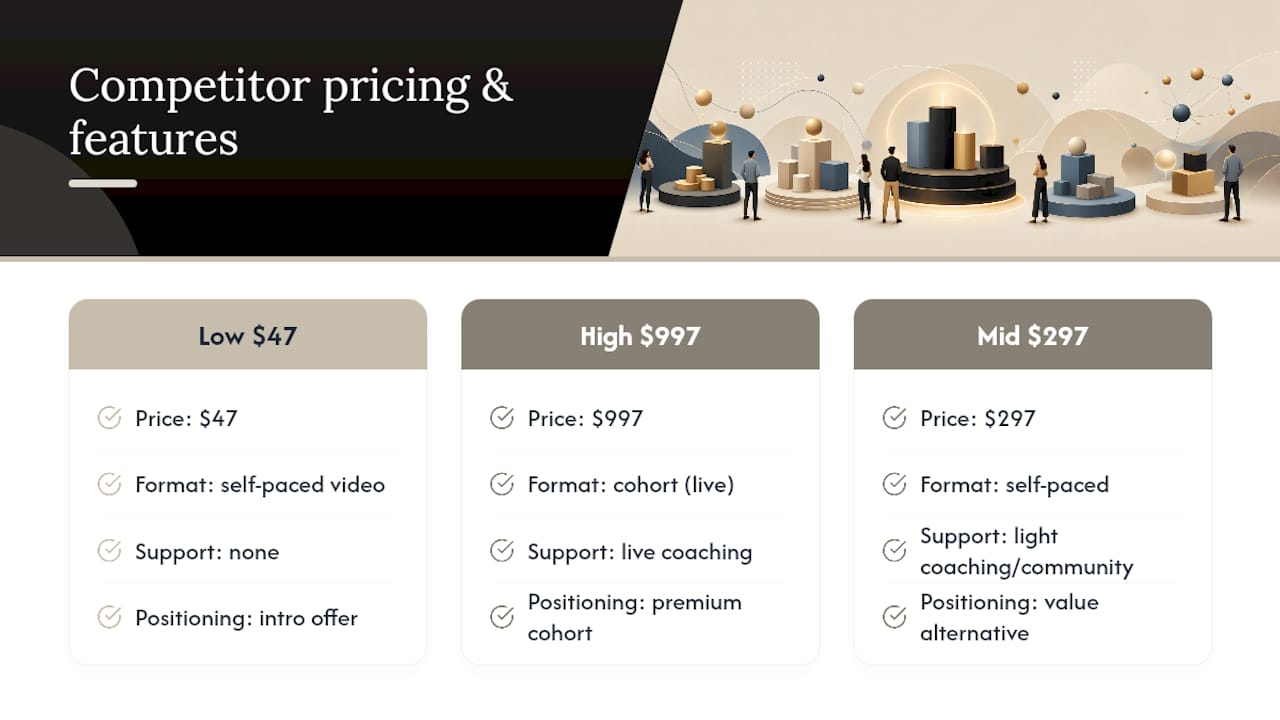
Start by mapping three to five direct competitors selling a similar transformation, not just a similar topic. A $47 "intro to Excel" course and a $997 "financial modeling for analysts" course both touch spreadsheets, but they solve different problems for different buyers. Compare what each competitor includes at their price point: hours of content, support level, community access, and whether they offer live components.
Pay attention to the gaps. If every competitor in your niche caps out at self-paced video with no support, a mid-priced tier that adds even light coaching or a community can justify a real premium. If the market is saturated with $997 cohorts, a well-positioned $297 self-paced alternative might capture buyers priced out of the premium options.
Formal pricing strategy training covers concepts like willingness-to-pay and price discrimination that explain why this works: different buyer segments have genuinely different ceilings, and competitor analysis helps you find which segment is underserved. Positioning matters as much as the number itself. A course priced at $497 marketed as "the fastest path to X" competes on a different axis than a $497 course marketed as "the most comprehensive guide to X," even at an identical price.
Revisit this analysis every few months. Course markets shift fast, and a price that looked competitive last year can look overpriced or underpriced today depending on what new entrants launch.
Segmenting Your Audience to Tailor Course Prices
Not every buyer in your audience has the same budget, urgency, or definition of success, and treating them identically leaves money on the table.
Beginners often need reassurance and structure, so they respond to lower-priced, highly guided entry offers. Career switchers and professionals chasing a promotion tend to have higher urgency and bigger budgets, since the outcome connects directly to income. Segmenting by outcome, not just by content, lets you build offers that match what each group is actually buying: a beginner buys clarity, a professional buys speed.
Practical segmentation shows up in your tier design and your marketing, not in separate courses. Offer your core content at one price for the general list, then layer a premium done-with-you tier aimed specifically at buyers who've signaled higher urgency, such as anyone who's asked about coaching or 1:1 support in a survey or DM. B2B or corporate buyers are worth a separate conversation entirely: they often have training budgets that support a materially higher price for the identical content, especially with a simple invoice option and a completion certificate.
Survey your list before you finalize tiers. A short poll asking what result they want and what they're currently struggling with tells you more about pricing tolerance than any competitor analysis. If half your list is beginners and half are experienced professionals, that split alone might justify building two distinct price points instead of one.
Strategies for Bundling Courses and Upselling
Bundling turns a single-course business into a portfolio, and it's one of the fastest ways to raise average order value without creating new content from scratch.
The simplest bundle pairs a foundational course with an advanced one at a combined price lower than buying both separately, but higher than either alone. This works because it removes the buyer's next decision: instead of finishing course one and wondering what's next, they've already paid for the path. A digital product bundle strategy built around complementary skills, rather than randomly grouped content, converts noticeably better than a generic "everything bundle."

Upsells work best immediately after purchase, while the buyer's intent is still warm. A one-time offer for a template pack, a private coaching call, or an accelerated cohort track shown right after checkout captures buyers who were already deciding to spend money. Don't wait for a separate email campaign to make that offer; the moment of purchase is when willingness to spend peaks.
Order bumps and downsells round out the toolkit. An order bump adds a small, cheap add-on (a workbook, a resource list) at the checkout screen itself. A downsell catches buyers who declined your main upsell and offers a scaled-down version at a lower price, recovering revenue you'd otherwise lose entirely. None of these tactics require new content, just smarter sequencing of what you already have.
What This Looks Like in Practice
The creators who get pricing right rarely start with the right number. They start with a pilot, watch how a real, paying group responds, and adjust from there instead of debating price in a spreadsheet for months.
Pick one course, run one pilot, in the next 30 days. The data you get back will tell you more than any framework alone.
— Anastasia
How Aria Helps You Run Pricing Experiments and Tiered Launches
Testing a course pricing strategy shouldn't require five different logins just to launch one pilot. Aria replaces the sales page tool, the payment processor, the community platform, and the email sequence with a single system, so setting up a pilot at a discounted price, collecting feedback, and rolling straight into your evergreen tiers happens without rebuilding anything.
Some platforms allow you to build a 3-tier price ladder as separate offers, attach payment plans directly to checkout, and create private community spaces for cohort-based pricing, all from the same dashboard used for sending launch emails. That matters most during a pilot, when you need to move fast and change pricing, copy, or bonuses without waiting on a developer. If you're planning your next launch, take a look at the full course and community platform and see what a pilot looks like when every piece lives in one place.
Sources
- How to Price An Online Course (2026): 10 Tips + Pricing Calculator
- Online Course Pricing Guide: How Much to Charge in 2026 | BuddyBoss
- How Much to Charge for an Online Course in 2026 (Real Pricing Data)
FAQ
What Are the 5 C's of Pricing?
Definitions vary across sources, but the concept generally refers to five factors that shape price: cost, customers, competition, channels, and company objectives. It's related to, but distinct from, the PRICE framework used specifically for course pricing.
What Are 7 Common Pricing Strategies?
Common approaches include value-based, cost-plus, competitor-based, penetration, skimming, tiered, and dynamic pricing. Course creators typically get the most traction from value-based and tiered pricing combined.
What Are the Five Main Pricing Strategies?
The five most widely used are cost-plus, value-based, competitor-based, dynamic, and freemium pricing. For online courses specifically, value-based pricing paired with a tiered structure tends to outperform pure cost-plus models.
What Are the Four Main Types of Pricing Strategies?
At the broadest level, pricing strategies fall into four categories: cost-based, value-based, competition-based, and dynamic pricing that adjusts based on demand or timing. Most course creators blend value-based pricing with dynamic elements like pilot discounts and enrollment windows.
How Much Should I Charge for My First Online Course?
Start with the 10x value rule to estimate what the outcome is worth, then test that number through a small pilot at 30 to 50 percent off before setting your final evergreen price. Most first courses land in the $297 to $997 range for a standard tier.