
The highest-leverage membership ideas right now fall into six buckets: coaching communities, premium newsletters paired with community access, trading or finance signal groups, micro-SaaS tools and templates, niche marketplaces, and hybrid course-plus-community models. Coaching and trading niches support premium pricing of premium monthly fees typically between $30 and $100 or more; newsletters and template libraries work better as high-volume, low-price offers around $5 to $20. A workable benchmark: 150 members at $40 a month is $6,000 in monthly recurring revenue, before you add a single upsell.
TL;DR:
- Community-first and hybrid models tend to retain members longer because they foster relationships rather than just offering content.
- Most membership revenue goals are achievable with around 150 to 200 members paying $40 to $50 monthly, depending on the model.
- The most effective retention tactics include automated onboarding, regular live office hours, member spotlights, and small accountability groups.
- Prioritizing an integrated platform that consolidates payments, community, and content saves costs and reduces operational complexity.
- Validating demand with a simple beta and running a founder discount helps mitigate early-stage risk and set realistic growth expectations.
Table of Contents
- Membership Site Ideas Grouped by Model, With Pricing Guidance
- How to Pick the Right Membership Model for Your Audience
- Pricing, Packaging, and the Revenue Math That Matters
- Retention Tactics That Actually Reduce Churn
- Choosing the Right Platform Category for Your Membership
- Why an Integrated Platform Saves Real Time and Money
- Legal and Compliance Basics You Cannot Skip
- Marketing Approaches Built for Membership Businesses
- Planning Content So Members Keep Getting Value
- Technical Basics: Payments, Data, and Access Control
- Publisher Perspective: What Actually Works for Creators Right Now
- How Aria Helps You Launch a Membership Without the Tool Sprawl
- Sources
- FAQ
Membership Site Ideas Grouped by Model, With Pricing Guidance
Most people picture a membership site as a locked course library. That's one format among many, and often not the most durable one. Community access, ongoing coaching, curated tools, and even physical-adjacent perks like member directories all qualify as membership businesses, and each one attracts a different kind of payer.
Below are the archetypes worth testing, organized by what you're actually selling.
Course-based and cohort models
What you offer: structured lessons released on a schedule, often with cohort start dates rather than instant access.
- Why it retains: a clear curriculum with deadlines keeps people from stalling out and canceling out of guilt.
- Price band: mid-range monthly prices or mid-thousands for cohort access.
- Example archetype: a 12 week marketing certification that reopens enrollment quarterly.
Cohort pacing works because it manufactures urgency without discounting. You're not selling access, you're selling a start date, and that scarcity does real work on conversion.
Community-first models
What you offer: a space to ask questions, share wins, and get peer feedback, with the creator present but not the entire product.
- Why it retains: the relationships members build with each other are stickier than any single piece of content.
- Price band: low to mid monthly fees.
- Example archetype: a private group for freelance designers trading client leads and rate benchmarks.
Community-first sites are the format Outseta's 2026 roundup of live membership examples points to repeatedly as the pattern behind the most durable, longest-running membership businesses. Members don't cancel a group where they have a reputation and ongoing conversations. They cancel a content library they stopped opening.
Newsletter plus community
What you offer: a paid newsletter as the anchor product, with a Discord or forum bolted on for discussion.
- Why it retains: the newsletter delivers a low-effort weekly touchpoint, and the community catches the people who want more.
- Price band: about ten to twenty-five dollars monthly or equivalent annually.
- Example archetype: a weekly industry-analysis email for SaaS founders with a members-only Slack for deal reviews.
Memberful's monetization framework treats newsletters as one of several revenue channels a single membership can stack, alongside courses, events, and sponsorships, rather than a standalone business. That stacking matters: a $12 newsletter with a $200 annual "insider" tier and one sponsored slot a month often outperforms a single flat price.
Coaching and mastermind groups
What you offer: direct access to you or a small coaching team, usually in small-group format with some 1:1 touchpoints.
- Why it retains: accountability and personalized feedback are hard to replace, so switching costs are high.
- Price band: premium pricing starting near a hundred dollars monthly.
- Example archetype: a 20-person business mastermind with monthly hot-seat calls and a shared accountability channel.
Masterminds carry the highest per-member price of any format on this list, but they cap out fast. You can only give real attention to so many people, which makes this a margin play, not a scale play.
Trading and finance signal groups
What you offer: market analysis, trade alerts, or portfolio commentary for an audience trying to make money from the information.
- Why it retains: members stay as long as they perceive the signals as paying for themselves.
- Price band: higher-end monthly pricing.
- Example archetype: a swing-trading alerts group with a live chat room during market hours.
Revenue-first analysis of membership niches consistently ranks trading and coaching communities at the top of achievable price points, because members are buying a direct line to income, not just information. That said, this category carries real regulatory weight. Anything resembling financial advice needs disclaimers and, depending on your jurisdiction, licensing. Don't skip that step to chase the higher price tag.
Micro-SaaS tools and templates
What you offer: a library of templates, spreadsheets, Notion systems, or a lightweight tool members get ongoing access to and updates for.
- Why it retains: you keep adding new templates, so canceling means losing future value, not just past access.
- Price band: under forty dollars monthly.
- Example archetype: a growing vault of email templates and automation workflows for e-commerce operators.
Niche marketplaces and directories
What you offer: a curated directory connecting buyers and sellers, freelancers and clients, or renters and landlords within a specific niche.
- Why it retains: both sides of the marketplace need the listing to stay live, which creates a natural reason to keep paying.
- Price band: $10 to $75 per month, sometimes with a transaction fee layered on top.
- Example archetype: a directory of vetted wedding vendors in a specific metro area, paid by the vendors.
Events and workshops
What you offer: a recurring calendar of live workshops, Q&A sessions, or skill-building intensives.
- Why it retains: the calendar itself becomes the reason to stay subscribed, since missing a month means missing that month's event.
- Price band: mid-tier monthly fees.
- Example archetype: a monthly live workshop series for small agency owners covering one operational topic per session.
Fitness and wellness subscriptions
What you offer: structured workout plans, live classes, or nutrition coaching delivered on a recurring basis.
- Why it retains: progress tracking creates a sunk-cost effect. Members don't want to lose their history.
- Price band: affordable to moderate monthly prices.
- Example archetype: a strength-training program with weekly video check-ins and a private progress-tracking group.
Meal planning and recipes
What you offer: weekly meal plans, grocery lists, and recipe collections tailored to a dietary approach.
- Why it retains: the weekly cadence makes the product part of a routine, not a one-time purchase.
- Price band: low monthly fees.
- Example archetype: a low-carb meal-planning service with printable grocery lists and a swap feature for allergies.
Parenting and family resources
What you offer: age-staged guidance, activity libraries, and a community of parents at the same stage.
- Why it retains: kids keep growing, so the content needs keep changing, and the community shifts with them.
- Price band: moderate monthly pricing.
- Example archetype: a membership offering monthly activity kits and milestone guides for parents of toddlers.
Hobby and collectibles clubs
What you offer: curated content, trading opportunities, or authentication resources for a specific hobby.
- Why it retains: passionate hobbyists rarely churn once they've found a group that speaks their language.
- Price band: moderate pricing levels.
- Example archetype: a vintage watch collecting community with authentication guides and a private trading board.
Job boards
What you offer: curated, niche-specific job listings, often paired with resume review or interview prep.
- Why it retains: active job seekers pay for as long as the search lasts, and passive members stay for market intelligence.
- Price band: pricing varies by user type from low monthly fees to premium employer rates.
- Example archetype: a remote-jobs board specifically for climate-tech roles.
Certification and professional development
What you offer: structured coursework leading to a credential or continuing-education credit relevant to a profession.
- Why it retains: many professions require ongoing credits, which turns renewal into a compliance need, not just a preference.
- Price band: monthly or annual fees in moderate ranges.
- Example archetype: a continuing-education platform for licensed contractors needing annual credit hours.
Local-affinity clubs, run virtually
What you offer: membership benefits tied to a specific city or region, delivered through an online hub. This mirrors how traditional associations structure member benefits: gated resources, a member directory, and event listings, just built for a niche geographic or professional community instead of a broad audience.
- Why it retains: local relevance and in-person meetup options make the group feel tangible, not purely digital.
- Price band: low to moderate monthly fees.
- Example archetype: a small-business owners' network in a mid-sized city, with monthly meetups and a shared vendor directory.
How to Pick the Right Membership Model for Your Audience
The model you choose should follow four factors: how often your audience needs what you're offering, how easily they can measure the return on what they pay, how much time you personally have to run it, and which monetization approach actually fits your content type. A high-frequency need (daily trading alerts) supports different pricing and delivery than a low-frequency one (quarterly certification renewal). Hybrid formats that combine structured curriculum with live community tend to outperform single-format memberships on long-term retention, because they give members both a reason to show up on a schedule and a reason to stick around between lessons.
Before you build anything, run your idea through this checklist over seven days:
- Willingness to pay. Ask ten people in your existing audience if they'd pay for this specific thing, not a vague version of it.
- Recurring pain. Confirm the problem shows up monthly, not once. A one-time problem is a product, not a membership.
- Unique access or experience. Identify what members get that they can't find free elsewhere, whether that's your specific frameworks or direct access to you.
- Ease of onboarding. Map out what a new member needs to do in their first week. If it takes more than three steps, simplify before launch.
- Pricing appetite. Test a real price in your pre-launch messaging, not a placeholder. Silence at $49 tells you something different than silence at $15.
- Distribution channel. Confirm you have at least one reliable way to reach new members monthly, an email list, a social following, or a partner audience.
If those six hold up, launch a minimum viable version: a founding-member beta capped at 20 to 50 spots, one simple pricing tier (skip the three-tier menu at launch), and a short onboarding sequence that gets new members to their first win within 48 hours. Track week-one activity and week-four retention before you touch paid ads.
Pro Tip: Run your founding cohort at a discounted "founder price" you clearly label as temporary, not permanent. It rewards early believers without boxing you into a price you'll regret raising later.
Pricing, Packaging, and the Revenue Math That Matters
Three price bands cover almost every membership idea on this list. Low-ticket sits at $5 to $15 a month and depends on volume: templates, meal plans, and niche newsletters live here. The sweet spot, $10 to $30, is where most community and course-based memberships land, balancing accessible pricing with real margin. Premium, $30 to $100 or more, belongs to coaching, masterminds, and trading groups where members expect direct access or measurable financial outcomes.
The math behind a revenue target is simple once you pick a band:
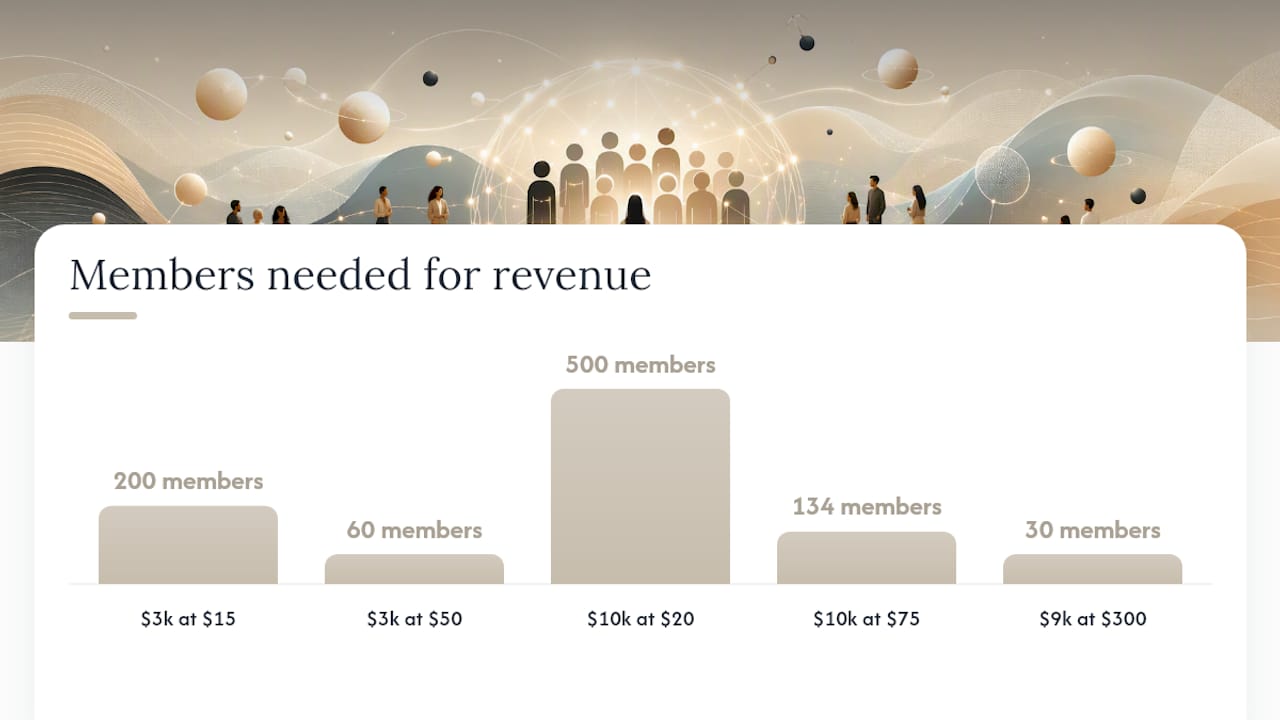
- $3,000 MRR at $15/month requires 200 members; at $50/month, just 60 members.
- $10,000 MRR at $20/month requires 500 members; at $75/month, roughly 134 members.
- A premium mastermind at $300/month reaches $9,000 MRR with only 30 members.
That math should drive your model choice more than personal preference. If you don't have the audience size to hit 500 members, a low-ticket newsletter membership won't get you to $10,000 MRR. A smaller, higher-touch offer will get there faster with a fraction of the audience.
On packaging: free tiers work well for community-first models where the free layer builds trust before the paid upgrade, but they rarely make sense for coaching or trading memberships, where the entire value is scarcity of access. Trials suit low-complexity products members can evaluate in a week. Founder pricing, a discounted rate for your first cohort, works everywhere, and it's the single easiest lever to accelerate early signups without cheapening the eventual full price. Tiered plans add complexity; only introduce a second tier once you have data showing members actually want more than the base offer, not because tiering feels like what memberships are "supposed" to do.
Retention Tactics That Actually Reduce Churn
Acquisition gets the attention, but retention is what determines whether a membership site becomes a real business or a revolving door. A handful of programs move the needle more than any content upgrade:
- Onboarding automation that walks new members through their first three actions in the first 48 hours, before novelty wears off.
- Cohort starts for course content, even inside an otherwise always-on community, to create shared momentum.
- Regular office hours, a recurring live call where members bring questions directly to you.
- Micro-challenges, short structured sprints (five to seven days) that reactivate members who've gone quiet.
- Member spotlights that highlight a member's win or project, which does double duty as social proof and engagement.
- Small-group accountability pods of four to six members who check in with each other weekly.
If you want a fast read on what actually moves retention, run a simple test in your first 90 days: put half of new members through a structured onboarding sequence with a personal welcome message, and leave the other half with your standard automated welcome. Compare 30-day retention between the two groups. The gap is usually large enough to settle the question quickly.
Track four numbers monthly: churn rate, the percentage of members active in the last 14 days, the number of engagement events (calls, challenges, threads) you ran, and a simple satisfaction score gathered through a one-question survey.
Pro Tip: Ask canceling members one question on the exit form: "What would have made this worth keeping?" The pattern in those answers is usually more useful than any retention dashboard.
Choosing the Right Platform Category for Your Membership
Platform choice comes down to trade-offs, not a single best answer. All-in-one SaaS platforms get you live fastest, with payments, community, and course delivery bundled together. Self-hosted CMS setups with membership plugins offer more control and ownership of your data, at the cost of more setup time and technical maintenance. Chat-based groups (Discord, Slack) are the cheapest way to start and validate demand, but they lack native payment gating and reporting. Micro-SaaS builders specialize in one function done well, useful if you need something specific your primary platform doesn't offer. Custom builds make sense only once you're at a scale where licensing costs justify engineering time. As one 2026 industry rundown of membership tools puts it, tool choice should follow the business model rather than trends, not the other way around.
Before choosing, run through a short technical checklist: does the platform handle recurring payments and failed-payment recovery, can you gate content by tier, does it give you real engagement analytics, can you automate onboarding emails, does it include a community space or require a separate tool, and does it back up member data automatically?
Whatever you pick, test payments and gated access with a small founder cohort before spending a dollar on marketing. A broken checkout flow discovered after an ad campaign launches is one of the most avoidable ways to lose early momentum.
Why an Integrated Platform Saves Real Time and Money
Running a membership business across five or six separate tools, one for payments, one for community, one for email, one for courses, one for scheduling, creates hidden costs that show up as wasted hours more than wasted dollars. Every integration between tools is a potential failure point: a payment that doesn't sync to your community access, a canceled member who still has course access because two systems didn't talk to each other.

Consolidating those functions into one platform means member data lives in one place. A new signup automatically gets tagged, enrolled, and welcomed without you stitching together three different automations across three different apps. That unified data also makes basic personalization possible, welcome sequences that reference what someone actually bought, renewal reminders timed to their specific billing date, without custom engineering.
If you're evaluating a vendor switch, keep the process simple:
- Run a trial with real content, not a demo account, before committing.
- Check the specific integrations you rely on today (email provider, payment processor, calendar tool).
- Estimate your current combined tool spend and compare it against one consolidated subscription.
- Migrate a small test group of members before moving your entire base over.
Legal and Compliance Basics You Cannot Skip
Every membership site needs three legal documents before it takes its first payment: a terms of service, a privacy policy, and a clear content-rights statement. Terms of service should spell out billing frequency, cancellation rights, refund policy, and what happens to member access if you shut the site down. Skipping this document is the fastest way to end up in a payment dispute you can't win, because you never defined the rules in writing.
Your privacy policy needs to disclose what member data you collect (email, payment details, activity data) and how it's stored and used. If you have members in the European Union, GDPR requirements apply regardless of where your business is based, including the right for members to request their data be deleted. Accessibility is worth building in from day one too: following W3C's Web Content Accessibility Guidelines reduces legal exposure and widens who can actually use your content, particularly for video-heavy or interactive membership products.
Content rights deserve their own line item, separate from generic terms. If members can post inside your community, your terms need to state who owns that content and what you're allowed to do with it, feature it in marketing, reference it in future courses, and so on. If you license outside content (stock footage, licensed data, guest expert material) into your membership, confirm your license actually covers redistribution to paying members, not just personal use. That distinction gets missed constantly, and it's an expensive mistake to discover after a cease-and-desist.
Marketing Approaches Built for Membership Businesses
Membership marketing works differently from one-time product marketing because you're not just selling a purchase, you're selling an ongoing relationship. Content marketing tends to be the strongest long-term channel: free content that demonstrates the value of your paid tier (a sample lesson, a free version of your newsletter, a public preview of your community discussions) does more to convert skeptical prospects than any sales page copy.
Paid advertising can work, particularly for well-defined niches with clear pain points like trading or professional certification, but it demands a tighter margin conversation than one-time products. You're paying to acquire a subscriber whose lifetime value depends entirely on retention, so don't scale ad spend until you know your churn rate well enough to calculate real lifetime value.
Referral programs consistently punch above their marketing budget for membership businesses, because your existing members are already proof that the offer delivers. A simple structure, one free month for both the referrer and the new member, or a small cash reward, costs less than most paid channels and brings in members who convert and retain better because they arrived through a trusted recommendation. Shopify's guidance on building membership programs points to referral incentives and clear promotional cadences as consistent drivers of sustained signups, particularly for consumer-facing membership offers.
Whichever channel you lean on, match your promise to your actual delivery. Overselling a membership in your marketing is the single fastest way to inflate month-one signups and month-two cancellations.
Planning Content So Members Keep Getting Value
The content that gets someone to join is rarely the content that keeps them subscribed past month three. New members join because of a specific promise, a course, a community, a resource library, but they stay because you keep delivering fresh, relevant value on a predictable schedule.
Build a content calendar around cadence, not volume. A weekly discussion prompt, a monthly deep-dive resource, and a quarterly live event give members three different reasons to check in without requiring you to publish daily. Batch production where you can: recording four weeks of video content in one sitting is far more sustainable than scrambling weekly.
Rotate delivery formats to match how people actually consume content. Some members want to read, some want video, some just want to show up live and ask questions. A membership that only offers one format naturally caps its own engagement, since not everyone learns the same way.
Finally, build a system for retiring or refreshing old content. A resource library that hasn't been updated in a year signals neglect, even if the original material still holds up. Set a quarterly review where you archive what's outdated and add at least one new resource, so returning members always find something they haven't seen.
Technical Basics: Payments, Data, and Access Control
Payment processing is the foundation everything else depends on. Your platform needs to support recurring billing, automatic retry logic for failed cards (a significant share of involuntary churn comes from expired or declined cards, not members actively canceling), and clear proration rules if members upgrade or downgrade mid-cycle.
Member data security matters more than most creators initially budget for. At minimum, your platform should encrypt payment data (ideally by never storing raw card numbers directly, relying instead on a PCI-compliant processor), limit staff access to member records on a need-to-know basis, and give you an audit trail if a data question ever comes up.
Access control is where a lot of membership sites quietly leak revenue. If your tiering isn't enforced cleanly, a member on your $15 tier finding their way into $75 tier content isn't a hypothetical, it's a common gap in platforms that weren't built with membership logic from the ground up. Test every tier boundary yourself before launch: log in as a basic member and confirm you genuinely cannot reach premium content through a stray link or old URL.
Backups round out the list. Your member database, your content library, and your billing history all need automatic backups independent of your primary platform. Losing member records because of a platform outage, with no independent backup, is the kind of failure that's entirely preventable and completely unforgivable once it happens.
Publisher Perspective: What Actually Works for Creators Right Now
Community-first and hybrid models keep winning, not because they're trendy, but because they solve the actual reason memberships fail: people cancel content, they don't cancel relationships. A pure content library, however good, competes with everything else in someone's feed for attention. A community where people know your name and you know theirs competes with almost nothing.
What gets underestimated is the time cost in month one and two. Most new membership owners plan for content creation and completely underplan for the manual, unscalable work of personally welcoming early members, answering their first questions, and noticing when someone's gone quiet. That work doesn't automate well early on, and skipping it is the most common reason founding cohorts churn before they ever become case studies.
The realistic pacing looks like this: your first 20 to 50 members will feel slow and manual. Members 50 to 200 are where retention systems either hold or crack. Price for the ROI a member actually gets, not for what feels comfortable to charge, and measure retention from week one, not month three when the damage is already done.
— Anastasia
How Aria Helps You Launch a Membership Without the Tool Sprawl
Most of the ideas above hit a wall at the same point: you validate demand, then discover you need five different subscriptions to actually run the thing, one for community, one for courses, one for payments, one for email, one for scheduling. Aria is built to remove that specific bottleneck. It combines community management, course delivery, membership billing, CRM, and marketing automation in a single interface, which means a new member's signup, tier access, and welcome sequence all run off the same data instead of three disconnected tools trying to sync.
An integrated platform fits best when you're trying to move from idea to launch quickly, or when you're already running a membership across scattered tools and feel the monthly bill creeping past what any single product should cost. Aria reports typical savings of over $700 a month in replaced tool subscriptions for creators consolidating their stack. If you're validating one of the models covered above, whether that's a coaching community, a hybrid course-plus-community offer, or a niche newsletter with a paid tier, you can explore Aria's platform and set up your first membership tier without stitching together a separate payment processor, community tool, and email platform first.
Sources
- Membership Models: How to Choose the Right One for Your Business — Thrive Themes
- The Complete Guide to Membership Monetization | Memberful
- Membership Site Examples 2026 — Outseta
FAQ
What are some creative ideas for membership benefits?
Strong benefits go beyond gated content: member directories, early access to new releases, live office hours, small-group accountability pods, and exclusive events all give members a reason to stay that a content library alone can't provide.
What is the best platform for creating a membership site?
The right platform depends on whether you value speed, control, or cost. All-in-one platforms like Aria combine community, courses, payments, and CRM in one system, which suits creators who want to launch fast without managing multiple integrations.
How do I create a membership site?
Validate demand with a six-question checklist covering willingness to pay and recurring need, then launch a founding-member beta with one simple pricing tier and a short onboarding sequence before adding complexity.
What are some engaging ideas for a membership campaign?
Founder pricing for early members, a public preview of your community discussions, and a referral incentive offering a free month to both parties tend to convert better than generic promotional discounts.