
Yes: integrating email and SMS into one coordinated program typically lifts engagement and conversions when you run channel-aware journeys, track deliverability, and respect consent. That lift depends on three things being in place first: proper consent handling for each channel, a shared customer profile that ties activity together, and deliverability controls that keep messages landing in inboxes and phones instead of spam folders or blocked numbers.
TL;DR:
- Combining email and SMS improves reach, shortens time-to-purchase, and sharpens personalization, especially when both channels are treated as one integrated program.
- SMS is ideal for immediate, short-term messages, while email handles detailed content; using both appropriately avoids redundancy and messaging noise.
- Customer profiles must store consent, purchase history, engagement, and preferences separately for each channel to ensure compliance and effective targeting.
- Running small pilot programs with holdout groups and analyzing revenue-per-recipient lift is the most effective way for small teams to justify broader integration efforts.
- Regulatory compliance requires separate consent records for email and SMS, with SMS needing explicit prior consent and prompt revocation, while email focuses on opt-out mechanisms.
Table of Contents
- 1. Top benefits of combining email and SMS
- 2. How email and SMS differ: channel roles and channel-first rules
- 3. Customer journey mapping with concrete channel sequences
- 4. Practical best practices for integrated campaigns
- 5. Consent, opt-in and opt-out rules for email vs. SMS
- 6. Measurement and KPIs for integrated programs
- 7. Deliverability and technical controls for email and SMS
- 8. Implementation playbook: a 30/60/90 day pilot plan
- 9. What small teams get wrong about integrated messaging
- Simplifying orchestration with an all-in-one platform
- Sources
- FAQ
1. Top benefits of combining email and SMS
Most businesses run email and SMS as separate systems, often with separate teams and separate rules. That split creates blind spots. A customer who ignores five emails might respond instantly to one well-timed text, but if the two channels never talk to each other, you never find that out.
Coordinating the two channels tends to produce three concrete outcomes.
- Reach improves because SMS catches people who don't check email daily, while email still handles detail-heavy content SMS can't.
- Time-to-purchase shortens when a short, time-bound SMS follows up on an email that got opened but not acted on.
- Personalization gets sharper because a shared customer record lets both channels reference the same purchase history, browsing behavior, or support ticket.
Deliverability itself is trending in the right direction. Validity's 2026 benchmark report documents rising global inbox placement, though performance still varies a lot by mailbox provider. That variance matters more once you're running two channels: a message that never reaches the inbox can't trigger the SMS follow-up you planned around it.
The businesses that see the clearest gains are the ones that treat email and SMS as one program with two delivery methods, not two programs that happen to target the same list.
2. How email and SMS differ: channel roles and channel-first rules
Email and SMS aren't interchangeable, and treating them that way is where most integration attempts go wrong. Each channel has a job it does well and a job it does poorly.
SMS is built for immediate, short, time-bound messages. A customer expects a text to be quick, relevant right now, and easy to act on with one tap. Email is built for longer content: product education, visual storytelling, receipts, and anything that benefits from formatting, images, or multiple calls to action.
A few channel-first rules keep the two from stepping on each other:
- Use SMS for anything with a short shelf life, like a two-hour flash sale reminder or a same-day appointment confirmation.
- Use email for anything that needs explaining, like a new product line, a policy change, or a detailed order summary.
- Never duplicate the same message on both channels at the same time. It reads as noise and trains people to ignore one of them.
- Match tone to expectation. Texts read as personal and direct; emails can carry more brand voice and visual polish.
Customers also hold the two channels to different standards. A text that arrives at 9 PM feels intrusive in a way the same message in an inbox doesn't. Respecting that difference is part of what makes the channels work together instead of competing for attention.
3. Customer journey mapping with concrete channel sequences
The clearest way to see integration working is to map it against real moments in the customer relationship. A few sequences show up across most businesses, regardless of industry.
- Welcome flow. Send an immediate SMS confirming signup or purchase, then follow with an educational email sequence over the next several days that introduces the brand, sets expectations, and highlights a first action to take.
- Cart recovery. Start with an email reminder a few hours after abandonment, then follow with a time-limited SMS nudge if the cart is still unclaimed, often framed around a short deadline.
- Post-purchase updates. Send the receipt and order details by email, since that's where people expect to find and search for them later, and reserve SMS for shipping or pickup updates that need to be seen fast.
- Win-back and reactivation. Re-engage lapsed customers with an email that reintroduces value, then test whether adding an SMS touch to a portion of that list produces meaningfully more reactivations than email alone.
Pro Tip: Run every new sequence against a small holdout group that gets no messages at all, so you can tell whether the sequence itself is working, not just whether people happen to buy anyway.
Timing matters as much as sequence. A cart recovery SMS sent six hours after an email reminder tends to perform differently than one sent immediately, since immediate SMS can feel aggressive while a same-day follow-up still feels timely. Testing the gap between touches is worth as much attention as testing the copy itself.

None of these sequences require every customer to get every channel. Segment by consent and by channel preference first, then layer the sequence logic on top.
4. Practical best practices for integrated campaigns
Once the channel roles and journey maps are set, the work shifts to operational discipline: what data you collect, how you segment, how you write copy that doesn't repeat itself, and how you test.
A shared customer profile is the foundation. Without it, email and SMS end up making separate decisions about the same person. Prioritize these fields when building or auditing that profile:
- Consent status and source for each channel, stored separately since SMS and email consent are legally distinct.
- Purchase and browsing history, so either channel can reference the same recent activity.
- Engagement recency per channel, so you know which channel a given customer actually responds to.
- Preferred contact windows, especially for SMS, where timing sensitivity is higher.
Segmentation for an integrated program works best when it's built around behavior and channel responsiveness rather than demographics alone. A customer who clicks emails but never responds to texts should get a different cadence than one who does the opposite. Trying to run identical sequences across every segment defeats the point of having two channels.
Copy and creative need their own rules to avoid duplication. If an email already explained a promotion in full, the SMS that follows should be a short nudge, not a recap. Write SMS copy assuming the recipient has ten seconds of attention. Write email copy assuming they've opted in for more detail.
Pro Tip: Draft the SMS follow-up for a sequence before the email, not after. It forces the email to earn its length instead of padding a message that could have been a text.
Testing priorities should include:
- A/B tests on subject lines and SMS opening lines, since both determine whether the rest of the message gets read.
- Cadence tests comparing different gaps between email and SMS touches in the same sequence.
- Holdout tests that isolate the incremental lift SMS adds to an existing email program, which is the clearest way to justify the added complexity.
A small pilot that measures revenue-per-recipient lift against a holdout group can make the business case for wider integration faster than any amount of internal debate. Research on revenue measurement in adjacent fields, like Amazon seller economics data, offers a useful model for how to structure that kind of incremental-lift analysis even outside ecommerce.
5. Consent, opt-in and opt-out rules for email vs. SMS
Email and SMS operate under different regulatory frameworks in the United States, and conflating them is one of the more expensive mistakes a marketing team can make.
For SMS, the FCC's TCPA rules require prior express consent for many autodialed or prerecorded commercial texts, and the agency has strengthened consumer revocation protections, recognizing that people can revoke consent by any reasonable method. The FCC's own consumer guidance reinforces that commercial texts generally need written consent and that opt-outs must be honored promptly.
For email, the FTC's CAN-SPAM compliance guide takes a different approach: it doesn't require prior opt-in for commercial email, but it does require a clear opt-out mechanism, valid sender identification, and applies a "primary purpose" test to determine whether a message counts as commercial.
Treat the two consent systems as entirely separate operational tracks. A checklist worth building into any integrated program:
- Capture consent per channel, never assuming an email opt-in covers SMS or vice versa.
- Store the exact disclosure text, timestamp, source, and a unique consent ID for every signup, which reduces risk if consent is ever disputed.
- Honor revocations immediately across every system that touches that customer's record, not just the channel where the opt-out arrived.
6. Measurement and KPIs for integrated programs
Open rates get treated as the default success metric, but they're increasingly unreliable, particularly on email, where privacy features and automated image loading inflate the numbers. Clicks, conversions, and replies tell you more about what people actually did.
A useful KPI mix for an integrated program includes:
- Inbox placement, tracked per mailbox provider rather than as a single blended number.
- Bounce and complaint rates, which signal list health and sender reputation.
- Clicks and conversions, the closest proxy for real engagement.
- Revenue per recipient, which ties messaging directly to business outcomes.
- Opt-outs, on both channels, as an early warning for fatigue or misfires.
| Metric | What it measures | Why it matters for integration |
|---|---|---|
| Inbox placement | Whether messages reach the inbox, not just the server | Validity's 2026 benchmark shows this varies significantly by provider |
| Clicks and conversions | Actual engagement and purchase behavior | More reliable than opens, which are distorted by privacy tools |
| Revenue per recipient | Business value generated per contact | Ties channel performance directly to outcomes |
| Opt-outs (email and SMS) | Channel fatigue or targeting misfires | Separate tracking per channel since drivers differ |
The most reliable way to prove that adding SMS actually helps, rather than just adding cost, is a holdout test: run the full integrated sequence for most of a segment, withhold the SMS touch from a comparable control group, and compare conversion and revenue outcomes between the two.
7. Deliverability and technical controls for email and SMS
Neither channel works if the messages don't arrive, and the technical setup behind delivery is where a lot of integration effort quietly fails.
For email, authentication is the baseline: SPF, DKIM, and DMARC need to be configured correctly and monitored on an ongoing basis, since a misconfiguration can silently tank inbox placement even while messages still "send" successfully. Feedback loops and postmaster tools from major mailbox providers give visibility into complaint rates and reputation that a delivery report alone won't show.
Validity's 2026 benchmark recommends monitoring inbox placement per mailbox provider rather than relying on an overall delivery number, since performance can vary a lot between providers.
For SMS, the technical considerations are different but just as important:
- Choose short code or 10DLC based on volume and use case, since each carries different throughput limits and carrier vetting requirements.
- Follow carrier content rules closely, since flagged language or link formatting can get messages filtered before they reach a phone.
- Format links carefully, using clean, trusted domains, since carriers actively screen for spammy-looking URLs.
- Monitor sender reputation the way you'd monitor email sender reputation, since carriers apply similar filtering logic.
Pro Tip: Check inbox placement by provider, not just overall delivery rate. A campaign that looks healthy on average can be quietly failing at one major provider.
8. Implementation playbook: a 30/60/90 day pilot plan
Trying to integrate every flow at once is how most projects stall. A time-boxed pilot proves the concept before you scale it.
Weeks 0 to 4:
- Run a consent audit across both channels, confirming what's properly documented and what isn't.
- Sync customer profiles so email and SMS activity live in one place.
- Pick a single pilot flow, cart recovery or welcome are usually the strongest candidates.
- Build templates and set up authentication (SPF, DKIM, DMARC) before sending anything new.
Month 2:
- Instrument measurement so clicks, conversions, and revenue per recipient are tracked from day one.
- Run A/B tests on copy and timing, and set up a holdout group to isolate incremental lift.
- Iterate cadence based on early results rather than waiting for a full quarter of data.
Month 3:
- Define scale criteria: a lift threshold the pilot needs to clear before expanding to more flows.
- Build automation templates for the next flow in line, using what the pilot proved.
- Set governance and suppression rules so consent, frequency caps, and opt-outs apply consistently as volume grows.
9. What small teams get wrong about integrated messaging
Most teams overbuild before they've proven anything. The instinct is to map every journey, connect every tool, and launch five sequences at once. That's backward. One pilot flow, measured against a holdout group, tells you more in three weeks than a fully built-out program tells you in three months, because you actually know whether the SMS touch is adding revenue or just adding cost.
Deliverability and compliance work is where DIY effort has real limits. Segmentation and copy testing are well within a small team's reach, but authentication setup and consent architecture are worth getting right the first time, since mistakes there are expensive to unwind later.
Use the pilot's numbers, not intuition, to make the case for expanding. A clear revenue-per-recipient lift against a holdout group is a stronger argument than any amount of enthusiasm about SMS as a channel.
— Anastasia
Simplifying orchestration with an all-in-one platform
Running email and SMS well requires a shared profile, consistent automation logic, and consolidated reporting, and stitching that together across separate tools is often where integration efforts lose momentum. Data silos between a CRM, an email platform, and an SMS tool mean the "shared customer profile" this article keeps returning to has to be built and maintained by hand.
A single platform can unify community management, courses, memberships, digital products, and marketing tools to operate from one interface rather than several disconnected subscriptions.
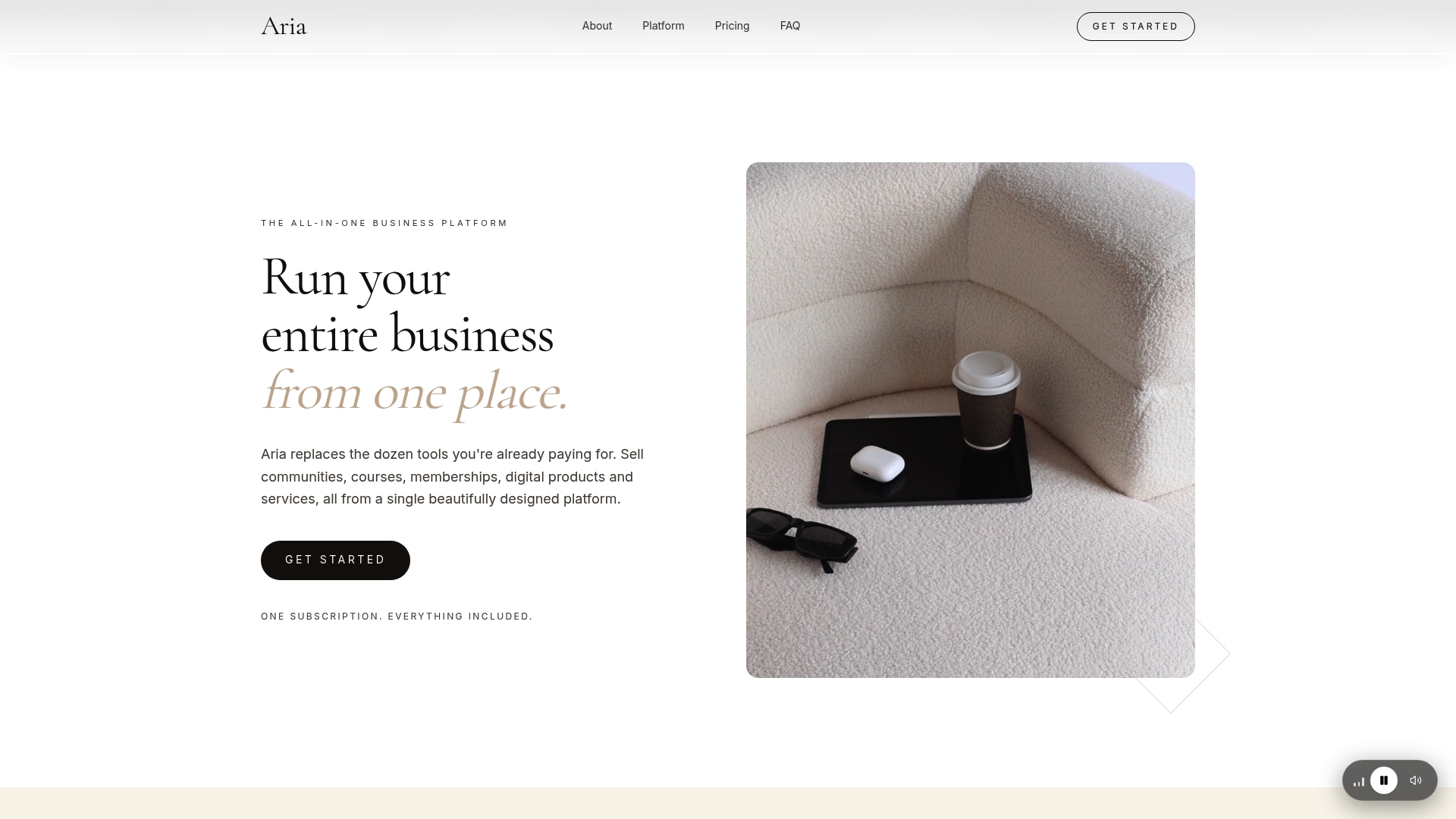 Such platforms often include a unified customer profile, automated workflows, CRM functionality, and integrated email and SMS marketing tools designed to work from the same customer data rather than separate systems. This consolidation can replace the need for multiple subscriptions, potentially saving users substantial monthly tool costs. For creators or small agencies running cart recovery or welcome sequences, having both channels read from one profile can remove steps that otherwise require custom integration work.
- Fit: creators, agencies, and small businesses looking to consolidate marketing, CRM, and operations into one system.
- Plans: Build at $197 per month, Grow at $297 per month, and Scale at $497 per month, each on Aria.
- Next step: review the plans and feature breakdown directly on the Aria site to see which tier matches your current tool stack.
Sources
- FCC Report and Order and Further Notice of Proposed Rulemaking (TCPA Consent Order)
- Stop Unwanted Robocalls and Texts — FCC
- CAN-SPAM Act compliance guide — FTC
FAQ
What is SMS and email marketing?
SMS and email marketing refers to sending promotional, transactional, or informational messages to customers through text messages and email respectively. When coordinated, both channels draw on the same customer data to send timely, relevant messages suited to each format's strengths.
What's the difference in regulations for email marketing and SMS marketing in the US?
SMS marketing generally requires prior express consent under FCC TCPA rules, with strong protections for consumers who revoke that consent. Email marketing under the FTC's CAN-SPAM Act doesn't require prior opt-in but does require a working opt-out mechanism and accurate sender information.
What's better, SMS or email marketing?
Neither channel is better outright: they serve different purposes. SMS suits urgent, short, time-bound messages, while email handles detailed, visual, or reference content, and combining both tends to outperform relying on either alone.
What is SMS in marketing?
SMS in marketing means sending short text messages, such as order updates, appointment reminders, or time-limited offers, directly to a customer's phone. It works best for messages that need to be seen and acted on quickly, complementing longer-form email content.